Author, Lecturer, Broadcaster & Cultural Arts Expert;
President of Art Collage JANG/J Music/J Art/J Books & Media.
Author of over 40 books published on Amazon, including The Crimson Horror series and The Great and Immortal Painters’ Stories series.
Dedicated to sharing insights into art, culture, literature, and creative expression through writing, lectures, media, and content creation.
Release date:
February 25, 1971 (London), January 24, 1971 (New York City), February 17, 1971
(United States)
Staff
Director: Ken
Russell
Producer:Ken
Russell
Screenplay:Melvyn Bragg
Music:André Previn
Cinematography:
Douglas Slocombe
Edited by:Michael
Bradsell
Cast
Richard
Chamberlain as Tchaikovsky
Glenda
Jackson as Nina (Antonina Milyukova)
Max
Adrian as Nikolai Rubinstein
Summary
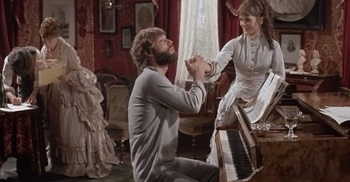
"The
Music Lovers" is a 1971 British drama film directed by Ken Russell and
starring Richard Chamberlain and Glenda Jackson. Based on "Beloved
Friend", a collection of personal correspondence edited by Catherine
Drinker Bowen and Barbara von Meck, Melvyn Bragg's screenplay focuses on the
life and career of 19th-century Russian composer Pyotr Ilyich Tchaikovsky.
Pyotr Ilyich Tchaikovsky
It
was one of the director's biographical films about classical composers, which
include “Elgar (1962)”, “Delius: Song of Summer (1968)”, “Mahler (1974)” and
“Lisztomania (1975)”, made from an idiosyncratic standpoint.
Mahler
Lisztomania
Movie Review
“Wonderful, one of Ken Russell's best”
“Peculiar and oddball Tchaikovsky biography in Ken Russell style”
“Ken Russell tries to understand Tchaikovsky, and at least he manages
to illustrate the case”
“Music and madness”
“Cinematic art by a consummate artiste”
“Tempestuous music demands a tempestuous drama”
“Nice autobiographical film with great visual style”
“My favorite film of all time”
The Behind Stories about the Film
1.
Some of the interior scenes of Madame Nadezhda von Meck's estate were later
used in Stanley Kubrick's“Barry Lyndon (1975).”
Madame Nadezhda von Meck
Barry Lyndon
2.
In the biography of Alan Bates, director Ken Russell mentioned that he had
offered Bates the role of Tchaikovsky while filming "Women in Love
(1969)." Bates admired the script, but he turned down the role.
Women in Love
3.
Ken Russell offered Glenda Jackson the role of Sister Jeanne in the film,
"The Devils (1971)”, his follow-up film to “The Music Lovers”. However,
Jackson turned down the role because she did not want to play another
over-the-top sexually neurotic female character so soon after Antonina. The role
went to Vanessa Redgrave.
Release
date: September 2009 (Russia), 4 November 2009
(France)
Staff
Director:
Radu Mihăileanu
Producer:Alain Attal
Written
by: Radu Mihăileanu,
Héctor Cabello Reyes, Thierry Degrandi, Matthew Robbins, Alain-Michel Blanc
Music:
Armand Amar, Tchaikovsky
Cinematography:Laurent Dailland
Edited
by: Ludo Troch
Cast
Aleksei Guskov as Andreï Filipov
Mélanie Laurent as Anne-Marie
Jacquet
Dmitry Nazarov as Sacha Grossman
Valeri Barinov as Ivan Gavrilov
François Berléand as Olivier Morne
Duplessis
Miou-Miou as Guylène de La Rivière
Lionel Abelanski as Jean-Paul
Carrère
Summary
“Le Concert” is a 2009 French comedy-drama film starring Aleksei Guskov and Mélanie Laurent and directed by Radu Mihăileanu. The film won the Best Original Score and Best Sound awards at César Awards 2010. It was also nominated for two Magritte Awards in the category of Best Film in Coproduction and Best Editing for Ludo Troch in 2011, and Best Foreign Film at the 68th Golden Globe Awards.
Plot
Andrey Filipov, who was a former conductor of the world-famous Bolshoi Theatre Orchestra, was deprived of his position as a conductor by rebelling against Leonid Brezhnev's order to protect the Jewish musicians in his orchestra. He becomes an alcoholic while working as a janitor in the theater where he once served as a conductor.
One day, while cleaning his boss's office, he sees and intercepts an official invitation from the famous Théâtre du Châtelet in Paris, which invited the Bolshoi Theatre orchestra to replace a concert of the Los Angeles Philharmonic Orchestra, which was canceled at the last minute. Filipov plans to rebuild his former orchestra by bringing old Jewish and Gypsy musicians together, members of his former orchestra who are now working as movers or taxi drivers to make a living. The plan is to perform in Paris and complete a performance of Tchaikovsky's Violin Concerto, which was interrupted 30 years earlier by former KGB Agent Ivan Gavrilov.
Filipov demands several conditions to the Châtelet, which has no choice but to accept their conditions, since the concert with the Bolshoi Theatre Orchestra are much cheaper than other orchestras. One of the conditions is that the solo violinist must be Anne-Marie Jacquet, who became famous for having never played Tchaikovsky's violin concerto because she is afraid of it.
She has long dreamed of playing it with the Bolshoi Orchestra, and especially with Filipov, whose fame has not declined outside Russia. Guylène de La Rivière, her agent and adoptive mother, is reluctant to allow that because she knows about Filipov and his past well, but Anne-Marie insists and eventually Riviere accepts the offer... (Continue)
Movie
Review
“Amazing movie about
music”
“Beautifully sad and funny
altogether”
“Simple and excellent”
“A Film not only for Movie
Lovers, but Mainly for Music Lovers”
“Food for the soul”
“Wonderful movie”
“A Harmonious Confession”
“Complete, superb!”
“Excellent movie, an
exciting combination of sound and storytelling”
Interesting
stories about the film
For her performance, Mélanie
Laurent studied violin for five months with Sarah Nemtanu of the Orchestre
National de France. In the film’s concert scene, since she learned all the bow
movements, her bowing was always accurate. However, her left hand was digitally
added or replaced during the editing process in post-production.
Today's
lecture is five operas featuring “Satire”, which were introduced in “The 43rd
ACJ Music Academy” on April 16, 2016.
1.
Die Fledermaus (Johann Strauss II)
2.
La Dame de Pique (Pyotr Tchaikovsky)
3.
Wozzeck (Alban Berg)
4.
Die Dreigroschenoper (Kurt Weill)
5.
Porgy and Bess (George Gershwin)
1. Die Fledermaus (Johann
Strauss II)
Die
Fledermaus is a three-act operetta composed by Johann Strauss II and the German
libretto was written by Karl Haffner and Richard Genée.
Eisenstein,
a male protagonist who lives luxuriously with interest income, is a typical
snob who prides himself on going in and out a noble salon. Although
he married Rosalinde, who has a good family and a beauty, to raise his poor
status, she is also a kind of snob, who despises her husband and likes to play
as much as her husband. Another important character is Adele, the maid of the
family. She
is living dreaming a star in her mind who receives a spotlight although her
status is a maid, as a singer or an actress emerges as the most promising job
for women.
Eisenstein assaulted a tax official and was sentenced to eight days’
custody, but thanks to the help by friends who bribed officials, he dresses up in
the evening when he has to go to jail and heads for the prom. Meanwhile, his
wife Rosalinde enjoys a meeting with an old lover, but the official, who comes to
arrest Eisenstein, thinks him as Eisenstein. Then, the official takes him into
custody and Rosalinde goes to the same prom without knowing that her husband
was there. Meanwhile, the maid Adele, who excused and had permission to go out,
disguises herself as an actress and attends the prom. They play in disguise and
eventually everything is revealed, but the couple reconcile with laughter, and
Adele, who recognized her talents for singing and acting, gets a sponsor and
becomes a real actress.
2. La Dame de Pique
(Tchaikovsky)
La
Dame de Pique is a three-act opera composed by Pyotr Ilyich Tchaikovsky. Based
on a novella of the same name by Alexander Pushkin, the composer's brother
Modest Tchaikovsky wrote a Russian libretto. The theme of the opera mainly
depicts the destructive and isolated nature of gambling addiction.
The
protagonist, a military officer Herman, who has no fortune and no good
background as well as is not a nobility, lives as an outsider without a chance
to get promoted in the military. One day, he sees Liza, the granddaughter and
heiress of the old Countess, and loves her at first sight. Although he knows
that she is engaged with Prince Yeletsky, he confesses passionately his love to
her.
The Countess is a social tycoon, who learned the secrets of the legendary
cards in her youth, collected a big fortune from gambling, and earned the
nickname “Spade Queen”. Knowing this, Herman attempts to find out the secret of
the cards by threatening the Countess with a pistol in a desire to make money
and live happily with Liza by gambling. However, the old Countess was so
surprised by this intrusion and threat that she collapses and dies on the spot,
and Liza is saddened by the thought that Herman approached not because he loves
her but because of the secret of the cards.
Liza
persuades Herman to go far away and live together, but believing that the ghost
of the dead Countess told him the secret of the cards of '3-7-Ace', Herman
pushes Liza, and runs to the gambling board, and desperate Liza commits suicide
on the river. As the ghost of the dead Countess showed, Herman, who earned big fortune
because the cards 3 and 7 were matched, is convinced his good luck against Yeletsky,
who was the fiancée of Liza, and bets all his fortune but the last card was not
an Ace, but a “Spade Queen” symbolizing death. Herman who lost his reason in
despair, commits suicide with a pistol on the spot.
3. Wozzeck (Berg)
Wozzeck
is the first opera of Alban Berg, composed between 1914 and 1922. The libretto
is based on the drama Woyzeck, which the German playwright Georg Büchner left
incomplete at his death.
The
background of the story is some watershed around 1820. The soldier, Wozzeck, who
is poor in physical condition and has nothing to boast, lives with his lover, Marie,
and a child. But since he has not been able to legally marry her because he has
no money, he lives under criticism and insults that he is immoral from his military
supervisors and those around him. In this situation of life, he shows
pathological anxiety and feels fear even when he sees the nature’s beauty.
After discovering a very unusual psychological disorder in him, the doctor
regulates his life and treats him like a marmotte such as making him eat only
certain foods and observing his reactions. Wozzeck becomes the subject of the
doctor's experiment, taking all kinds of the insults to earn the minimum cost
of living to support Marie and his child. However, when Marie is fascinated by a
strong and handsome military band commander and falls into his temptation, Wozzeck
struggles to get her back and fights with him, but he is just only a laugh of
people. Watching Marie and the military band commander dance passionately at
the village festival, Wozzeck, who lost his reason, takes Marie to the forest,
stabs with a knife and kills her, and then he returns to the village. Then, in
the confusion, he goes back to the forest and walks into the water of the swamp
to wash his bloody hands, and eventually drowns.
4. Die Dreigroschenoper (Kurt
Weill)
The
Die Dreigroschenoper is a play by Bertolt Brecht with music by Kurt Weill. It
was written between early March and August in 1928, and premiered at Berlin's
Theater am Schiffbauerdamm on August 31, 1928.
Mackie
Messer is the leader of the gang, and Peachum is the controller of all the
beggars in London. Since Police Chief of London Brown, who served in the military
with Mackie together in the past, doesn't arrest him. Peachum makes a beggars
company and he makes beggars wear outfits causing more sympathy when begging,
such as crutches or rags, and earns money every day from the beggars. When Mackie
gets married by tempting Polly, the daughter of Peachum, Peachum sends Mackie to
prison, but just before the hanging is executed, Brown appears with the letter
of pardoning of queen. Mackie escapes from the execution and becomes rather
rich.
5. Porgy and Bess (George
Gershwin)
Porgy
and Bess is an English-language opera of three acts composed by George
Gershwin, with a libretto written by DuBose Heyward and Ira Gershwin. It
was adapted from Dorothy Heyward and DuBose Heyward's play “Porgy”, itself an
adaptation of DuBose Heyward's 1925 novel of the same name. All
these works cover the lives of African Americans in Catfish Row, a fictitious village,
in Charleston, South Carolina in the early 1920s.
The
story is set in the city of Charleston, South Carolina, in the early 1920s. The
protagonist, Porgy, is a disabled beggar, who makes a living with selling a
soap in the street, and young and charming Bess is Crown's lover, who is a bully
on the harbor. One day, when Crown kills a man and is chased by the police, Bess,
who has no place to go, finds a refuge from Porgy. Porgy, who has loved Bess,
takes care of her, and the two become lovers.
However, returned Crown laughs at
Porgy and tries to kill Bess. Porgy, trying to protect Bess, kills Crown after
a fight. Arrested Porgy is released innocent because no one has seen the scene
of the murder, and returns to the village with cheers of the people in the
town. However, it was after Bess, who thought Porgy will never return, touches
the drug again in despair and left for New York, falling into temptation of
Sportin' Life, a drug dealer and smuggler. However, Porgy does not lose hope, and
again pulls the goat's wagon and goes a long way to find Bess.
You
can listen to all the arias selected in this course from following YouTube
link.
1.
“Mein Herr Marquis”, Die Fledermaus (Johann Strauss II)
2.
“Chto nasha zhizn? Igra!”, La Dame de Pique (Pyotr Tchaikovsky)
3.
“Wir arme Leut!”, Wozzeck (Alban Berg)
4.
“Die Seerauber-Jenny”, Die Dreigroschenoper (Kurt Weill)