Showing posts with label Igor Stravinsky. Show all posts

Thursday, February 17, 2022

109. Classical Music: 24. Dmitri Shostakovich, ACJ Music Academy


How are you?

This week's lecture is “Dmitri Shostakovich”, the 24th and last topic of Classical Music, which is a summary of the contents of 109. Classical Music: 24. Dmitri Shostakovich introduced on November 4th, 2017.

Dmitri Shostakovich was a Soviet-era Russian composer and pianist born on September 25, 1906 and died on August 9, 1975. He is regarded as one of the major and most popular composers of the 20th century.


Birthplace of Shostakovich


Shostakovich gained fame in the Soviet Union under the patronage of Mikhail Tukhachevsky, the Soviet chief of staff, but later had a complicated relationship with the government, from which he got state awards and privileges. He also held bureaucratic posts during his lifetime, including activity in the Supreme Soviet of the Soviet Union from 1962 until his death.


Mikhail Tukhachevsky


Shostakovich combined a variety of musical techniques into his work, whose music is characterized by sharp contrasts, elements of the grotesque and ambivalent tonality. He was also heavily influenced by the neoclassical style pioneered by Igor Stravinsky and, particularly in his symphonies, by Gustav Mahler's late Romanticism.


Igor Stravinsky


Gustav Mahler


Shostakovich's orchestral works include 15 symphonies and 6 concerti. His chamber works include fifteen string quartets, one piano quintet, two piano trios and two for string octet. His piano solo works include two sonatas, an early collection of 24 preludes, and a later collection of 24 preludes and fugues. His other works include three operas, three ballets, several song cycles, and a significant amount of music for theatre and film. 


Shostakovich (1950)


Among the film music he made, the waltz from the 1955 film “The First Echelon” and the suite of music from the film “The Gadfly”, are especially famous.


The First Echelon


The Gadfly


Thank you.


Related Music

Amazon Author Page

Lecture Program List

YouTube

Blog (Korean)

Naver TV


Thursday, February 3, 2022

108. Classical Music: 23. Igor Stravinsky, ACJ Music Academy


How are you?

This week's lecture is “Igor Stravinsky”, the 23rd topic of Classical Music, which is a summary of the contents of 108. Classical Music: 23. Igor Stravinsky introduced on October 28th, 2017.

Igor Stravinsky was a Russian composer, pianist and conductor born on June 17, 1882 and died on April 6, 1971.


Igor Stravinsky (1903)


Stravinsky first gained international fame with three ballets, “The Firebird”, “Petrushka” and “The Rite of Spring”, commissioned by Sergei Diaghilev, founder of the Ballets Russes, and premiered in Paris by Ballets Russes.


Sergei Diaghilev by Léon Bakst (1906)


In particular, The Rite of Spring has contributed greatly to Stravinsky's lasting reputation as one of the revolutionary works that have broken static music boundaries and many composers have since arranged for their tastes.


Group of supporters and members of the Ballets Russes
(1911)


The earliest period in the evolution of Stravinsky's musical style is the ‘Russian period (c. 1907–1919)’, the period began with works created under the tutelage of Nikolai Rimsky-Korsakov from 1905 to the death of Rimsky-Korsakov in 1908.


Stravinsky and Rimsky-Korsakov seated together on the left
(1908)


The ‘Neoclassical period (c. 1920–1954)' is a period in which Stravinsky not only returned to the music of the Classical period, but also explored the themes from the ancient Classical world, such as Greek mythology.


Igor Stravinsky by Pablo Picasso (1920)


In the 1950s, Stravinsky was making a transition to the ‘Serial period (1954-1968)', where he began to use serial compositional techniques such as dodecaphony, the twelve-tone technique originally devised by Schoenberg.


Stravinsky conducting (1965)


Stravinsky is widely considered one of the most important and influential composers of the 20th century and a pivotal figure in modernist music.


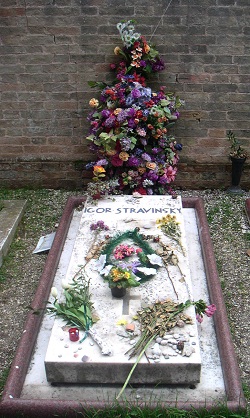
Stravinsky's grave on San Michele Island


Thank you.


Related Music

Amazon Author Page

Lecture Program List

YouTube

Blog (Korean)

Naver TV


Monday, June 22, 2020

The Stories about Music Films: 13. Coco Chanel & Igor Stravinsky (2009)


Basic Info

Title: Coco Chanel & Igor Stravinsky
Genre: Drama
Country: France
Language: French/English
Running time: 118 minutes
Release date: 24 May 2009 (Cannes), 30 December 2009 (France)

Staff

Director: Jan Kounen
Producer: Chris Bolzli, Claudie Ossard
Written by: Chris Greenhalgh
Music: Gabriel Yared
Cinematography: David Ungaro
Edited by: Anne Danché

Cast

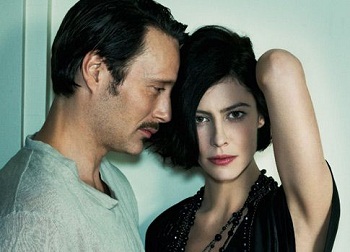
Mads Mikkelsen as Igor Stravinsky
Anna Mouglalis as Coco Chanel
Elena Morozova as Catherine Stravinsky
Natacha Lindinger as Misia Sert
Grigori Manoukov as Sergei Diaghilev
Rasha Bukvic as Grand Duke Dmitri
Nicolas Vaude as Ernest Beaux
Anatole Taubman as Boy Capel
Marek Kossakowski as Vaslav Nijinsky
Jérôme Pillement as Pierre Monteux

Summary


Coco Chanel & Igor Stravinsky” is a 2009 French romantic drama film directed by Jan Kounen. The film was selected as the Closing Film of the 2009 Cannes Film Festival and was shown on May 24, 2009The film is based on 2002 fictional novel "Coco and Igor" by Chris Greenhalgh and traces a rumored affair between Coco Chanel and Igor Stravinsky in Paris in 1920, the year the Chanel No. 5 was created.

Plot


The film begins with the attendance of Coco Chanel at the premiere of Igor Stravinsky's “The Rite of Spring", which was a scandalous performance, in Paris in 1913. In this performance, the rhythmic and harmonic dissonance of the music and the surprising choreography of the work provoke the heckling and outrage of many audiences, but Chanel is impressed by Stravinsky and his music.

Seven years later, Chanel and Stravinsky meet again. Although her business flourished, Chanel was grieved by the death of her lover Arthur "Boy" Capel, and Stravinsky decided to flee to France after the Russian Revolution. At this time, Chanel and Stravinsky feel sympathy and charm each other.

Chanel invites Stravinsky to live with his sick wife and children in her villa outside Paris, after which the two begin an inappropriate affair. As a result, tensions between Stravinsky and his wife, and his wife and Chanel are escalated.

The film suggests that the affair, which was later ended by Chanel, had a significant influence on the lives of both Chanel and Stravinsky. During this period, Chanel creates Chanel No. 5 with her perfumer, Ernest Beaux and Stravinsky starts composing in a new and more liberated style. While living at the villa, he devotes himself to revising The Rite of Spring.

One of the last scenes in the film shows the revival of this work with new choreography, showing that it was an artistic victory and recognized as a masterpiece.

Movie Review


Wonderful”
A Masterpiece of Cinematography”
A mixture of Chanel No. 5 and the music of Stravinsky”
Must-see”
Two different cultures”
Two Passions, Condensed”

Interesting stories about the film


1. The ballet "The Rite of Spring", which premiered on May 29, 1913, portrayed in the film, is rarely performed as a ballet today and used as a concert piece for orchestras. Also, Nijinsky's original choreography has disappeared.
2. Chanel and the former chief designer of Chanel, Karl Lagerfeld, supported the production of the film by allowing access to Chanel's archives and the apartments in which Chanel lived.
3. The lead actress, Anna Mouglalis, has actually appeared in several Chanel advertising campaigns.
4. The film was released almost concurrently with the 2009 film "Coco avant Chanel," directed by Anne Fontaine and starring Audrey Tautou as Coco Chanel.

Thank you.


Tuesday, May 12, 2020

COMPOSER OF THE WEEK: 10. Igor Stravinsky


Born: June 17, 1882; Lomonosov, Saint Petersburg, Russia
Died: April 6, 1971; New York City, New York, USA

Igor Stravinsky was a Russian composer, pianist and conductor who was born on June 17, 1882 and died on April 6, 1971. Stravinsky's career as a composer, considered as one of the most important and influential composers of the 20th century, is known for its diversity of styles. 

Stravinsky's house in Ustilug, now a museum

He first achieved international fame with three ballets, which were commissioned by Serge Diaghilev, who led the Ballets Russes, and first performed in Paris by the Ballets Russes, ‘The Firebird (1910)’, ‘Petrushka (1911)’, and ‘The Rite of Spring (1913)’. In particular, The Rite of Spring, considered one of the revolutionary works which has broken the boundaries of traditional musical frame, has been transformed by a lot of subsequent composers and made a great contribution to Stravinsky’s continued reputation. 

Sergei Diaghilev

The first period in the process of changing Stravinsky's musical styles was the “Russian period (c. 1907–1919)”. The Russian period, also called "Primitive period", except for a very few surviving earlier works, began with works made under the guidance of Nikolai Rimsky-Korsakov from 1905 until 1908 when Rimsky-Korsakov died.

Group of supporters and members of the Ballets Russes (1911)

Following the ‘Russian period’, which continued with works such as Renard, L'Histoire du soldat, and Les Noces, Stravinsky changed his music style to ‘neoclassicism’ in the 1920s. The ‘Neoclassical period (c. 1920–1954)' was a period when Stravinsky not only returned to the music of the Classical period but also explored the themes from the ancient Classical world, such as Greek mythology. Apollon musagète (1928),  Perséphone (1933) and Orpheus (1947) are good examples for the period. 

Stravinsky and Rimsky-Korsakov (seated together on the left) (1908)

The works of this period also showed a tendency to use traditional musical styles such as concerto grosso, fugue, and symphony, and used early styles, especially those of the 18th century. Important works in this period include the Octet (1923), the Concerto for Piano and Winds (1924), the Serenade in A (1925), and Symphony of Psalms (1930). 

Portrait of Igor Stravinsky, Pablo Picasso

In the 1950s, Stravinsky turned to the ‘Serial period (1954–1968)’, which began to use serial compositional techniques such as dodecaphony, the twelve-tone technique originally devised by Arnold Schoenberg. However, in the early stages of this period, Stravinsky experimented with non-twelve-tone serial techniques in small-scale vocal and chamber works such as the Cantata (1952), the Septet (1953) and Three Songs from Shakespeare (1953).

Stravinsky's grave, San Michele Island

Thank you.


🌙 “After Midnight, Before Dawn” | Smoky Female Vocal Jazz

After midnight, before dawn, there is a kind of loneliness that doesn't need to speak loudly.   “After Midnight, Before Dawn” is an...