How are you?
Modigliani Institute Korea (MIK) is
currently introducing artworks of Amedeo Modigliani one by one every week.
The 26th work to introduce for this
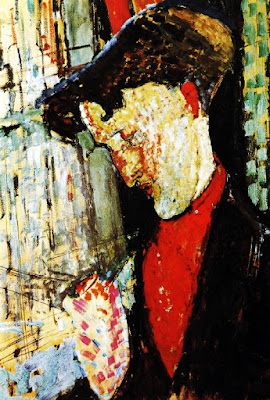
week is “Portrait of Frank Burty Haviland (1914)”.
This work is a portrait of an
expressionist style and an oil painting on cardboard with the size of 72.5 x
59.5 cm.
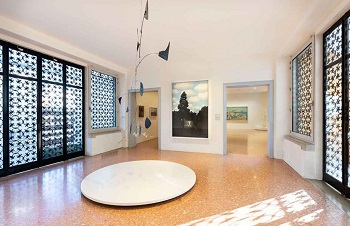
It is currently owned by the Peggy
Guggenheim Collection in Venice, Italy.
The model for this work, “Frank
Burty Haviland,” was a French cubist painter who was born on October 16, 1886
in Limoges and died in Perpignan in November 1971. He was a friend and a client of
Picasso and Braque, and a collector of African art.
Haviland was also the grandson of
"Philippe Burty", an art collector and critic who coined the term
"japonisme." Philippe's daughter, Madeline Burty,
married Charles Haviland, the owner of the porcelain company "Haviland and
Company".
Haviland lived most of his life in Céret
and was one of the driving forces behind the creation of the “Musée d'Art
Moderne de Céret,” founded in 1950. He also helped the museum acquire 14
works by Henri Matisse and over 50 works by Pablo Picasso.
Painted in Paris by Modigliani in
1914, this portrait marks his return to painting after a period of more than
four years dedicated to sculpture. Haviland, who had a large
collection of African sculptures, became close with Modigliani when he gave up
sculpture and returned to painting.
In addition to this work by
Modigliani, Havilland was presumed to be a model of “The Smoker (1913)” by Juan
Gris and “Le Rouquin (1917~1919)” by Chaim Soutine.
In this work, Modigliani portrays
the head of Haviland as if it were a sculpture made of stone. The biggest reasons why Modigliani
abandoned the sculpture were that it was difficult to obtain the stone for the
sculpture due to the war, and his health was deteriorated due to the work on
engraving. Therefore, this work shows that
although Modigliani had returned to painting, he still had some regrets about the
sculpture and thus it is thought that Modigliani expressed Haviland's head as a
sculpture to reflect his regret in this work.
Modigliani also experimented with
various styles, trying to establish his definitive style by returning from
sculpture to painting, and this work illustrates such efforts of Modigliani. For example, in this work, the elements
of "Pointillism" as well as those of "Fauvism" in intense colors, were reflected. However, the techniques of Pointillism
used by Modigliani are not systematic but intuitive and free.
It can be seen that they differ
from the theoretical and systematic Pointillism techniques applied by Georges
Seurat and Paul Signac, who were the representative artists of the Pointillism. In other words, Modigliani's use of
the Pointillism techniques in this work is entirely experimental and temporary. As mentioned earlier, Modigliani
was trying to find his definitive style, so it seems that he could try various
styles in this work without the obligation and restrictions of using a specific
style.
It is certain that Modigliani intentionally
elongated the head of Haviland in a way that reflected the influence of the
African sculptures which Modigliani was fascinated and the fact that Haviland
was an ardent collector of African art.
Also, in this work, the image of Haviland,
with the red cravat, brown jacket, the aquiline nose, small mouth and central
parting of the hair, shows a sophisticated aesthetic such as Oscar Wilde, who was an Irish poet
and playwright, reflecting that Haviland is a sophisticated artist from a
wealthy family.
And the deeply thoughtful
appearance of Havilland, holding a pipe in his hand and staring down, seems to
suggest that he was a cautious and speculative artist.
Thank you.