Thursday, December 2, 2021

The Stories about Art Films: 49. Maudie (2016), ACJ Movie Academy


Basic Info


Title: Maudie

Genre: Biography, Drama, Romance

Country: Ireland, Canada

Language: English

Running time: 116 minutes

Release date: 2 September 2016 (Telluride Film Festival), 14 April 2017 (Canada), July 2017 (Ireland)


Staff


Director: Aisling Walsh

Produced by: Bob Cooper, Mary Young Leckie, Mary Sexton, Susan Mullen

Screenplay: Sherry White

Music: Michael Timmins

Cinematography: Guy Godfree

Edited by: Stephen O'Connell


Cast


Sally Hawkins as Maud Lewis

Ethan Hawke as Everett Lewis


Summary


"Maudie" is a 2016 biographical drama film directed by Aisling Walsh and starring Sally Hawkins and Ethan Hawke. A co-produced by Ireland and Canada, the film is about the life of Canadian folk artist Maud Lewis.


Maud Lewis


Maud Lewis was a Canadian folk artist from Nova Scotia who was born on March 7, 1903 and died on July 30, 1970. She lived most of her life in poverty in a small home in Marshalltown, Nova Scotia, and she achieved first national recognition in 1964 and 1965. Best known for her cheerful paintings of landscapes, animals and flowers that evoke a nostalgic and optimistic vision of her native province, Lewis is one of Canada's most famous folk artists. Her works and the restored Maud Lewis House are displayed in the Art Gallery of Nova Scotia.


Winter Sleigh Ride, Maud Lewis


Model T Ford, Maud Lewis


In the film, Maud (Hawkins) struggles with arthritis, memory of a lost child, and a family who doubts her ability, before moving as a housekeeper to the home of a surly fish peddler (Hawke). Despite their different personalities, as her works gain popularity, the two get married. The film was shot in Newfoundland and Labrador and a re-creation of Lewis' small house was made for the filming.

The film, which premiered at the 2016 Telluride Film Festival, was screened in the Special Presentations section at the 2016 Toronto International Film Festival and received positive reviews after its release.

Although the fact that the film was shot in Newfoundland became the controversial subject in Lewis' native Nova Scotia, it sparked a resurgence of interest in Lewis' art.


Movie Review
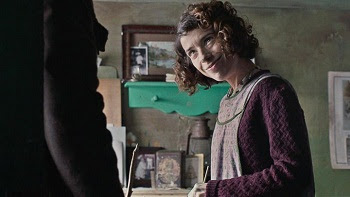


"Beautiful location, beautiful artist”

Sally Hawkins is amazing”

Expresses her joy in life through art”

Outstanding bio-pic of Canadian artist Maud Lewis”

Gorgeous...”

An inspiring and heartfelt story”

A lovely story, well told”

A gentle portrait of a gentle artist”

A sentimental story”


Interesting stories about the film


1. This film project was in development for 13 years.


A filming location, Trinity Bay, Newfoundland and Labrador


2. The fully restored house of Maud Lewis is on permanent display in Halifax at the Art Gallery of Nova Scotia.


Art Gallery of Nova Scotia, Halifax, Nova Scotia, Canada


3. An entire replica of Lewis's house was made for the making of the film.


Maud Lewis Replica House, Digby, Nova Scotia, Canada


4. Ethan Hawke based his character's grunting on a lobster fisherman he once knew.


Ethan Hawke


5. This film won the Super Channel People's Choice Award, the top audience award at the festival for feature films, at the 2016 Vancouver International Film Festival, which was the opening gala.


Aisling Walsh and Sally Hawkins at the
Berlinale 2017


6. This is the first biopic about artist Maud Lewis.

7. The filmmakers decided not to emphasize Lewis' physical conditions, as it was not the entirety of her identity.


Thank you.


Movie Trailer

Amazon Author Page

Lecture Program List

YouTube

Korean Blog

Naver TV


Monday, November 29, 2021

Amedeo Modigliani in Worldwide Museums: 2. The Hecht Museum


How are you?

The second place I would like to introduce for this week is The Hecht Museum in Haifa, Israel.

The Hecht Museum is a museum located at the University of Haifa in Israel, and was inaugurated in 1984 by Dr. Reuben Hecht, founder of the Dagon Silos and a founding member of the University of Haifa’s Board of Governors.


Dr. Reuben Hecht


Dr. Hecht, who was interested in the archeology of the Land of Israel from his youth, assiduously collected archaeological artifacts representing the material culture of the Land of Israel in ancient times for sixty years. He was particularly interested in artifacts from the Canaanite period to the end of the Byzantine period.


He also believed that archeology was an important expression of Zionism and that the discovery of ancient artifacts was proof of the link between the Jewish people and the Land of Israel.

The museum's exhibits display the archeology and history of the Land of Israel in chronological sequence from the Chalcolithic period to the Byzantine period. The museum's art collection includes French painting of the Barbizon School, Impressionism, Post-impressionism, and the School of Paris, and Jewish art from mid-nineteenth to early twentieth century. The museum owns paintings by Jean-Baptiste-Camille Corot, Édouard Manet, Claude Monet, Camille Jacob Pissarro, Vincent van Gogh, Amedeo Modigliani, and Max Liebermann.


About two years before his death, Dr. Hecht began planning an expansion of the museum. The administrators of the University of Haifa and the directors of the Hecht Foundation continued the plan, and the new building of the museum was inaugurated in October 1998.


The Hecht Museum serves as a study and research center for students and academic staff, as well as a venue providing in-depth studies in the fields of archeology, art, history and the Bible for students, soldiers, teachers and the local public. The Museum also holds conferences, symposia and cultural events for youngsters and adults.

Modigliani's works currently housed in the Hecht Museum are as below:


Nu au chapeau (Nude with a Hat) (1908)


Portrait of Maud Abrantes (1908)


Thank you.


Amazon Author Page

Lecture Program List

YouTube

Korean Blog

Naver TV


Friday, November 26, 2021

103. Classical Music: 18. Sergei Rachmaninoff, ACJ Music Academy


How are you?

This week's lecture is “Sergei Rachmaninoff”, the 18th topic of Classical Music, which is a summary of the contents of 103. Classical Music: 18. Sergei Rachmaninoff introduced on September 16th, 2017.

Sergei Rachmaninoff, born on April 1, 1873 and died on March 28, 1943, was a Russian composer, pianist and conductor of the Late Romantic period. In his early works, the influence of Tchaikovsky, Rimsky-Korsakov, Balakirev, Mussorgsky, and other Russian composers is seen, but later he built his own style known for song-like melodicism, expressiveness and rich orchestral colours.


Rachmaninoff at age 10


He was born into a noble family in the Russian Empire. His paternal grandfather, Arkady Alexandrovich, was a musician who learned music from the Irish composer John Field. His father, an army officer and amateur pianist, Vasily Arkadyevich Rachmaninoff, married the daughter of a wealthy army general, Lyubov Petrovna Butakova, and the couple had three sons and three daughters, Sergei being their fourth child.


Vasily Arkadyevich Rachmaninoff


Lyubov Petrovna Butakova


Starting piano at the age of 4, Rachmaninoff graduated from the Moscow Conservatory in 1892, and at the time he already had several piano and orchestral pieces he had composed.


The Moscow Conservatory


However, in 1897, when his “Symphony No. 1” received the negative response, Rachmaninoff suffered from depression for four years and composed little until successful treatment made him complete his “Piano Concerto No. 2”, which received enthusiastic responses. 


Rachmaninoff in 1897, the year his
Symphony No. 1 premiered


For the next 16 years, Rachmaninoff conducted at the Bolshoi Theatre, moved to Dresden, Germany, and toured the United States for the first time. He often used the piano in his compositions and explored the expressive possibilities of the instrument through his unique techniques as a pianist.


The Bolshoi Theatre in 1905, during Rachmaninoff's time as
conductor


Following the Russian Revolution, Rachmaninoff and his family left Russia and settled in New York City in 1918. His main source of income was piano and conducting performances, but the reduced composition time due to the tight performance schedule made him complete only six works between 1918 and 1943, including the "Rhapsody on a Theme of Paganini", "Symphony No. 3" and "Symphonic Dances.” By 1942, his health deteriorated and he moved to Beverly Hills, California.


Statue commemorating Rachmaninoff's last
concert, Knoxville, TN


Rachmaninoff's health deteriorated rapidly in the last week of March 1943. He lost consciousness on March 26 and died two days later, four days before his 70th birthday.

His funeral was held at the Holy Virgin Mary Russian Orthodox Church in Silver Lake. Rachmaninoff wished to be buried at Novodevichy Cemetery in Moscow, but was eventually interred at Kensico Cemetery in Valhalla, New York.


Rachmaninoff's grave at Kensico Cemetery


Thank you.


Related Music

Amazon Author Page

Lecture Program List

YouTube

Blog (Korean)

Naver TV


🎨 🎵 “The Quiet Gothic”: Turning Grant Wood’s “American Gothic” Into Music

"Every masterpiece has a melody. Welcome to Melodies on Canvas." What kind of music would you hear if you could listen to a pa...