Thursday, December 9, 2021

104. Classical Music: 19. Jean Sibelius, ACJ Music Academy


How are you?

This week's lecture is “Jean Sibelius”, the 19th topic of Classical Music, which is a summary of the contents of 104. Classical Music: 19. Jean Sibelius introduced on September 23rd, 2017.

Jean Sibelius, born on December 8, 1865 and died on September 20, 1957, was a Finnish composer and violinist of the late Romantic and early-modern periods.


Sibelius (1913)


He is recognized as Finland's greatest composer, and his music is credited with helping Finland develop a national identity during its struggle for independence from Russia.

The core of his works is his seven symphonies, performed and recorded regularly in Finland and many other countries, like his other major works. His other famous works include Finlandia, the Karelia Suite, Valse triste, the Violin Concerto, the choral symphony Kullervo, and The Swan of Tuonela (from the Lemminkäinen Suite).


Finlandia premiere edition


Sibelius was born in Hämeenlinna in the Grand Duchy of Finland, an autonomous part of the Russian Empire. He was the son of the medical doctor Christian Gustaf Sibelius and Maria Charlotta Sibelius. His surname comes from the Sibbe estate in Eastern Uusimaa, which was owned by his paternal great-grandfather.


Sibelius's birthplace in Hämeenlinna


Sibelius composed prolifically until the mid-1920s, but after completing his Seventh Symphony (1924), the incidental music for The Tempest (1926) and the tone poem Tapiola (1926), he stopped composing for his last 30 years, commonly referred to as the "silence of Järvenpää", derived from the place where his home was located. However, even during this period, when it is known that he stopped composing, traces of his efforts to continue composing can be seen such as his eighth symphony.


Jean Sibelius and wife Aino in Ainola's dining room


He died of a brain haemorrhage on the evening of September 20, 1957 in Ainola at the age of 91. At the time of his death, his Fifth Symphony, conducted by Sir Malcolm Sargent, was being broadcast via the radio in Helsinki, and at the same time as the UN General Assembly in progress, Sir Leslie Munro of New Zealand, who was the then-General Assembly President, ordered a moment of silence, saying, "Sibelius belonged to the whole world. With his music, he enriched the life of the entire human race”. Sibelius was honored with a state funeral and buried in the garden at Ainola.


Sibelius's funeral in Helsinki (1957)


Finland's 100 mark note featured his image until 2002, when the euro was adopted. Since 2011, the Finnish government has celebrated a flag flying day on December 8, the composer's birthday, also known as the "Day of Finnish Music". In 2015, in celebration of the 150th anniversary of the composer's birth, many special concerts and events were held, especially in Helsinki, the Finnish capital.


The Sibelius Park in Kotka, Finland


Thank you.


Related Music

Amazon Author Page

Lecture Program List

YouTube

Blog (Korean)

Naver TV


Monday, December 6, 2021

Interesting Art Stories: 66. The Two Fridas, Frida Kahlo, ACJ Art Academy


How are you?

Currently, I am introducing the stories about various artists and their paintings with the title Interesting Art Stories.

The 66th story is The Two Fridas by Frida Kahlo.

"The Two Fridas" is an oil painting by Mexican artist Frida Kahlo, considered Kahlo's first large-scale work and one of her most notable paintings. The painting is a double self-portrait of two versions of Kahlo sitting together, one wearing a white European-style Victorian dress while the other wearing a traditional Tehuana dress.


Frida Kahlo


Kahlo painted the painting in 1939, the same year she divorced artist Diego Rivera, although they remarried a year later. According to Kahlo's friend, Fernando Gamboa, the painting was inspired by two paintings that Kahlo saw at the Louvre earlier that year: "The Two Sisters" by Théodore Chassériau and "Gabrielle d'Estrées and One of Her Sisters" by the anonymous painter.


The Two Sisters, Théodore Chassériau
(1843)


Gabrielle d'Estrées et une de ses soeurs, unknown artist
(c. 1594)


In the painting, the Frida in Mexican costume is holding a small portrait of Diego Rivera and the Frida in European costume is holding forceps. Blood spills onto her white dress from a blood vessel that has been cut by the forceps, and it seems to indicate the tragic motor accident that left her with many of her surgeries and long bedridden throughout her life. 

The blood vessel connects the two Fridas as it runs through the European Frida’s hands and connects to her heart and again connects to Mexican Frida's heart. Both Fridas show an open heart, but Mexican Frida's heart looks healthy, while European Frida's heart appears to be amputated and ill. 

Together with the constant pain that Frida is going through, the painting suggests two separate personalities, the strong Frida and the weak Frida. However, despite these differences, the blood vessel connecting the two Fridas suggests that although the two Fridas have separate personalities, they must be combined together to become perfect Frida.

The painting was exhibited along with “The Wounded Table” by Kahlo at the International Surrealist Exhibition in Mexico City in January 1940.


The Wounded Table, Frida Kahlo (1940)


It was owned by Kahlo until it was taken over by the Instituto Nacional de Bellas Artes (INBA) in 1947, which transferred it to the Museo de Arte Moderno in Mexico City, where is currently housed, on December 28, 1966.


Museo de Arte Moderno, Mexico City


Thank you.


Amazon Author Page

Lecture Program List

YouTube

Korean Blog

Naver TV


Thursday, December 2, 2021

The Stories about Art Films: 49. Maudie (2016), ACJ Movie Academy


Basic Info


Title: Maudie

Genre: Biography, Drama, Romance

Country: Ireland, Canada

Language: English

Running time: 116 minutes

Release date: 2 September 2016 (Telluride Film Festival), 14 April 2017 (Canada), July 2017 (Ireland)


Staff


Director: Aisling Walsh

Produced by: Bob Cooper, Mary Young Leckie, Mary Sexton, Susan Mullen

Screenplay: Sherry White

Music: Michael Timmins

Cinematography: Guy Godfree

Edited by: Stephen O'Connell


Cast


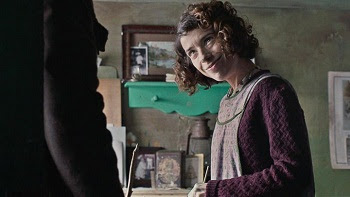
Sally Hawkins as Maud Lewis

Ethan Hawke as Everett Lewis


Summary


"Maudie" is a 2016 biographical drama film directed by Aisling Walsh and starring Sally Hawkins and Ethan Hawke. A co-produced by Ireland and Canada, the film is about the life of Canadian folk artist Maud Lewis.


Maud Lewis


Maud Lewis was a Canadian folk artist from Nova Scotia who was born on March 7, 1903 and died on July 30, 1970. She lived most of her life in poverty in a small home in Marshalltown, Nova Scotia, and she achieved first national recognition in 1964 and 1965. Best known for her cheerful paintings of landscapes, animals and flowers that evoke a nostalgic and optimistic vision of her native province, Lewis is one of Canada's most famous folk artists. Her works and the restored Maud Lewis House are displayed in the Art Gallery of Nova Scotia.


Winter Sleigh Ride, Maud Lewis


Model T Ford, Maud Lewis


In the film, Maud (Hawkins) struggles with arthritis, memory of a lost child, and a family who doubts her ability, before moving as a housekeeper to the home of a surly fish peddler (Hawke). Despite their different personalities, as her works gain popularity, the two get married. The film was shot in Newfoundland and Labrador and a re-creation of Lewis' small house was made for the filming.

The film, which premiered at the 2016 Telluride Film Festival, was screened in the Special Presentations section at the 2016 Toronto International Film Festival and received positive reviews after its release.

Although the fact that the film was shot in Newfoundland became the controversial subject in Lewis' native Nova Scotia, it sparked a resurgence of interest in Lewis' art.


Movie Review


"Beautiful location, beautiful artist”

Sally Hawkins is amazing”

Expresses her joy in life through art”

Outstanding bio-pic of Canadian artist Maud Lewis”

Gorgeous...”

An inspiring and heartfelt story”

A lovely story, well told”

A gentle portrait of a gentle artist”

A sentimental story”


Interesting stories about the film


1. This film project was in development for 13 years.


A filming location, Trinity Bay, Newfoundland and Labrador


2. The fully restored house of Maud Lewis is on permanent display in Halifax at the Art Gallery of Nova Scotia.


Art Gallery of Nova Scotia, Halifax, Nova Scotia, Canada


3. An entire replica of Lewis's house was made for the making of the film.


Maud Lewis Replica House, Digby, Nova Scotia, Canada


4. Ethan Hawke based his character's grunting on a lobster fisherman he once knew.


Ethan Hawke


5. This film won the Super Channel People's Choice Award, the top audience award at the festival for feature films, at the 2016 Vancouver International Film Festival, which was the opening gala.


Aisling Walsh and Sally Hawkins at the
Berlinale 2017


6. This is the first biopic about artist Maud Lewis.

7. The filmmakers decided not to emphasize Lewis' physical conditions, as it was not the entirety of her identity.


Thank you.


Movie Trailer

Amazon Author Page

Lecture Program List

YouTube

Korean Blog

Naver TV


🎨 🎵 “The Quiet Gothic”: Turning Grant Wood’s “American Gothic” Into Music

"Every masterpiece has a melody. Welcome to Melodies on Canvas." What kind of music would you hear if you could listen to a pa...