Author, Lecturer, Broadcaster & Cultural Arts Expert;
President of Art Collage JANG/J Music/J Art/J Books & Media.
Author of over 40 books published on Amazon, including The Crimson Horror series and The Great and Immortal Painters’ Stories series.
Dedicated to sharing insights into art, culture, literature, and creative expression through writing, lectures, media, and content creation.
The project proposal I submitted to Wadiz Co, a representative crowdfunding company in South Korea, was finally approved, and my funding project was opened on Wadiz.
The title of the project is “Making Artworks Catalogues of Claude Monet” and the purpose of the project is to make catalogues of the French Impressionist artist Claude Monet.
Monet's catalogues to be produced this time is one of artists’ catalogues that I have produced so far, and I came to know Wadiz while considering the production by my own cost.
Looking at Wadiz's information, I learned that it is a representative crowdfunding company in South Korea, so I thought of trying to make the Monet's catalogues through crowdfunding with Wadiz.
The catalogues are planned to be produced in two volumes, one is a collection of Monet's general paintings and the other is a collection of only Monet's series paintings.
I am sure that the catalogues of Monet to be produced this time will be precious and valuable books for those who love art and especially for those who love Monet.
The link below is my crowdfunding project page opened in Wadiz.
After experiencing great difficulties in offline lectures
for a long time due to the COVID19 crisis, I start offline lectures again from June
2022.
First of all, I would like to inform you of my lecture
schedule for June 2022, which is next month, and I will again inform you of my
lecture schedule for July 2022 in next month.
In the next month, June 2022, a total of 4 lectures hosted
by the Gangnam branch, Shinsegae Academy are being prepared. The title
of my lecture is “The Great and Immortal Painters’ Stories.”
This lecture has been popular at various institutions
such as Mapo Lifelong Learning Center and Seongdong-gu Library, and you can also
find the content in my books.
Please refer to following details of my lecture for next
month at Gangnam Branch, Shinsegae Academy.
1. Lecture Title: The Great
and Immortal Painters’ Stories
2. Lecture content
1) Introduction of the selected artist’s life and
interesting stories
2) Introduction of a film featuring the selected
artist
3) Select the music that matches with the selected
artist's life and work as background music for slideshow of the appreciation of
the artist's works
Currently, I am introducing
the stories about various artists and their paintings with the title
“Interesting Art Stories”.
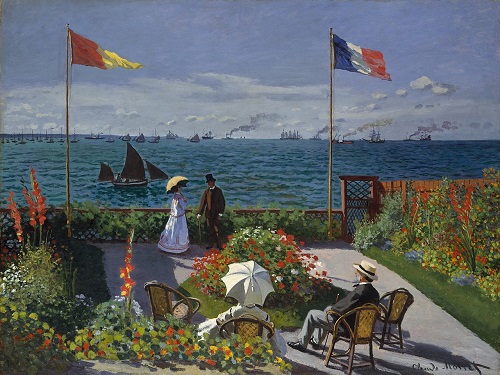
The 76th story is “Garden at
Sainte-Adresse” by Claude Monet.
Claude Monet
The “Garden at Sainte-Adresse” is a painting
by the French Impressionist painter Claude Monet. Monet spent the summer of
1867 with his family at Sainte-Adresse, a seaside resort near Le Havre, France.
In this painting, he painted his father and other relatives as models, in a
garden with a view of Honfleur on the horizon.
Régates à Sainte-Adresse, Claude Monet (1867)
Le Havre (September 2019)
Although this painting shows a scene of
wealthy family, it is by no means a portrait of a harmonious family. This is
because Monet's relationship with his father was tense that summer, because of
his family's objection to his marriage to Camille Doncieux, his wife-to-be.
Camille Doncieux
Camille (The Woman in a Green Dress), Claude Monet (1866)
In his letter, Monet called this painting
"the Chinese painting in which there are flags" and his friend
Pierre-Auguste Renoir called it as "the Japanese painting". The
horizontal layers of colors that make up this painting are reminiscent of the
Japanese color wood-block prints, which were eagerly collected by Monet, Manet,
Renoir, Whistler and other colleagues. The print that appears to have inspired
this painting is “Turban-shell Hall of the Five-Hundred-Rakan Temple (1830)”,
the Woodblock print by Japanese artist Katsushika Hokusai.
Turban-shell Hall of the Five-Hundred-Rakan Temple, Katsushika Hokusai (1830)
In this painting, Monet emphasized the
two-dimensionality of the painting by using the elevated vantage and relatively
even sizes of the horizontal areas.
The painting was exhibited at the 4th
Impressionist exhibition in Paris from 10 April to 11 May 1879 under the title
“Jardin à Sainte-Adresse”.
The painting was acquired by the Metropolitan
Museum of Art in New York City through an auction sale at Christie's in
December 1967.
Entrance façade of The Metropolitan Museum of Art (The Met)
Currently, I am
introducing the stories about various artists and their paintings with the
title “Interesting
Art Stories”.
The 43rd story is“Impression,
Sunrise” by Claude Monet.
“Impression,
Sunrise” is a painting by Claude Monet that was first shown at the “Exhibition
of the Impressionists” in Paris in April 1874 and inspired the birth of the
name of the Impressionist movement.
Claude Monet
Depicting the port of Le Havre, Monet's
hometown, it is now on display at the Musée Marmottan Monet in Paris.
Musée Marmottan Monet
Monet visited his hometown
of Le Havre in 1872 and painted a series of six works depicting the port of Le
Havre. This series depicts the varying viewpoints of the sea and the port of Le
Havre from a hotel room looking down over the port at different times such as
dawn, day, dusk, and dark.
Le Havre (2019)
This painting became the
most famous in the series after being displayed at the Paris exhibition in
April 1874. Among thirty artists who participated in the exhibition, Monet,
Edgar Degas, Camille Pissarro, Pierre-Auguste Renoir, and Alfred Sisley led the
exhibition, and about 4,000 people, including unsympathetic critics, saw more
than 200 works on display at the exhibition.
Catalogue for the 1874 Impressionist Exhibition
In 1985, the painting was
stolen by Philippe Jamin and Youssef Khimoun from the Musée Marmottan Monet,
recovered and returned to the museum in 1990 and displayed again in 1991.
Monet claimed that he titled
the painting as “Impression, Sunrise” due to the hazy painting style. The
critic Louis Leroy, who saw the 1874 Impressionist exhibition, wrote a review
about the exhibition for the newspaper Le Charivari, using the term
"Impressionism" to describe the new style of work displayed in the
exhibition, which he said that Monet’s painting represents the term.
Louis Leroy
The painting depicts the
port of Le Havre at sunrise, the two small ships in the foreground and the red
Sun as the subject element of the painting, and the hazy scene of the painting
deviates from traditional landscape paintings and the classic, ideal beauty.
There are more fishing boats
in the middle of the painting and fishing boats with tall masts on the left side
of the background. Behind them are other misty shapes that are not trees, but
smokestacks of pack boats and steamship, while on the right in the distance are
other masts and chimneys against the sky. In order to express these features of
industry in the Le Havre at the time, Monet excluded existing houses on the
left side of the jetty from the painting, leaving the background unobscured.
The port of Le Havre, which
flourished after the defeat of France in the Franco-Prussian War of 1870-71,
was one of the centers of French regeneration. Representing Le Havre, Monet's
hometown and a center of French industry and commerce, this painting represents
the renewed strength and beauty of France and the ultimate utopian ideal of
Monet, demonstrating France’s revitalization after the war.
After the 1874 exhibition
and the rise of the Impressionist movement, although their subjects varied,
Monet recalled the painting by giving similar titles to other works. Examples
of such works are “Effet de brouillard, impression (1879)”, “L’Impression
(1883)”, “Garden at Bordighera, Impression of Morning (1884)”, “Marine
(impression) (1887)” and “Fumées dans le brouillard, impression (1904)”.
Garden at Bordighera, Impression of Morning (1884)
In addition to this
painting, Monet's other paintingson the theme of Le Havre are as follows.



.jpg)
.jpg)

,%20Claude%20Monet%20(1866).jpg)
.jpg)
.jpg)


