Showing posts with label Falstaff. Show all posts

Tuesday, June 30, 2020

COMPOSER OF THE WEEK: 17. Giuseppe Verdi


Born: October 10, 1813; Le Roncole, Italy
Died: January 27, 1901; Milan, Italy
Nationality: Italian
Occupation: Composer

Giuseppe Verdi was an Italian opera composer who was born on October 10, 1813 and died on January 27, 1901. He was born in a moderate-class family near Busseto and studied music with the help of a local patron. 
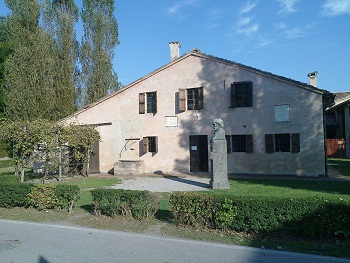
Verdi's childhood home, Le Roncole

Verdi possessed a dominant place in the genre of Italian opera after the era of Vincenzo Bellini, Gaetano Donizetti, and Gioachino Rossini, whose works significantly influenced him.

In his early operas, Verdi showed interest in the Risorgimento movement in pursuit of the unification of Italy, and as an elected politician, he also participated for a while. The chorus “Va, pensiero” from his early opera, “Nabucco (1842)” and similar choruses in later operas reflected the spirit of this Italian unification movement, and Verdi was respected as a representative of these ideals. 

The portrait of Giuseppe Verdi, Giovanni Boldini

However, Verdi, who was a very private person, after succeeding as an opera composer and being able to reduce the amount of opera-making work, tried to live an ordinary life by owning the land in his hometown. However, Verdi, who succeeded in the opera “Aida (1871)”, returned to the musical world and then with his late three masterpieces, “The Requiem (1874)” and the operas “Otello (1887)” and “Falstaff (1893)”, he surprised the musical world.

Verdi conducting the Paris Opera premiere of Aida in 1880

In his last years, Verdi did many philanthropic ventures, publishing a song in 1894 for the benefit of earthquake victims in Sicily, and from 1895 planning, building and donating a shelter for retired musicians in Milan, and building a hospital close to Busseto. While staying at the Grand Hotel in Milan, Verdi suffered a stroke on January 21, 1901 and died on January 27 at the age of 87.
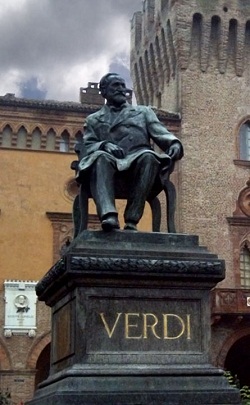
The statue of Verdi, Busseto

His body was initially buried in a private ceremony at Milan's Cimitero Monumentale and then a month later moved to the crypt of the Casa di Riposo. At this time, the opera Nabucco's “Va, pensiero” was conducted by Arturo Toscanini along with a chorus of 820 singers, and a huge crowd of about 300,000 attended the ceremony.
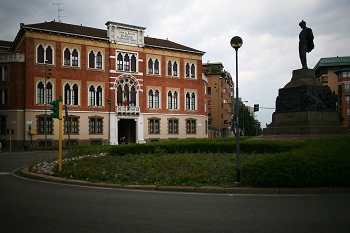
Casa di riposo per musicisti, Milano
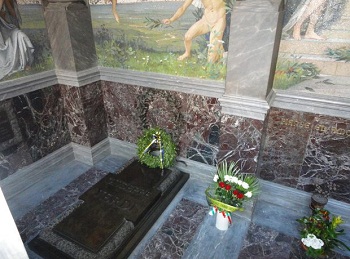
Verdi's grave, the Casa di Riposo, Milan

Today, his opera is still very popular and the 2013 bicentenary of his birth was widely celebrated in broadcasts and performances.

Thank you.


Friday, February 7, 2020

35. Opera 1: Identity, ACJ Music Academy


How are you?

Following the last week, I am going to start my 35th lecture.

I had conducted music lectures at Art Collage JANG in Seoul, South Korea every Saturday from March 2015 to December 2017.

I am going to introduce the lecture by the lecture’s order every Saturday.

Please refer to the following link for my previous lectures.

https://blog.naver.com/csydr/220995605864

The music genre starting from this week is opera


The opera lecture for this week was the 35th lecture of ACJ Music Academy on February 20, 2016. The theme of the operas is “Identity” treating conflicts between nobles, commons, servants, maids or demons. I introduced 50 operas over 10 weeks, with 5 operas every week by theme.

1. La Serva Padrona (Pergolesi)


La Serva Padrona is an opera buffa by Giovanni Battista Pergolesi, calling “Mozart of Italy”, to a libretto by Gennaro Federico based on the play of Jacopo Angello Nelli. It is regarded as an important work bridging the gap between Baroque and Classical periods. An elderly Uberto, who remains single, declares his marriage because he is so hard to live with Serpina, who is his maidservant. However suddenly lost her job and has loved Uberto for many years, Serpina tries to stop his marriage by disguising one servant as a soldier, deceiving him as her fiancé, and asking Uberto for a dowry. Surprised with the dowry and felt compassion to Serpina who has to be married to a man looking wild, Uberto decides to marry her, and eventually clever Serpina has both identity and love.

2. Don Giovanni (Mozart)


It is an opera written by Mozart in 1787 with an Italian libretto by Lorenzo Da Ponte.
The main character, Don Giovanni, seduces Donna Anna and her father, the Commendatore, became angry. Then Don Giovanni kills the Commendatore with his sword during a duel. But afterwards, he keeps seducing women, enticing the country virgin Zerlina, and sees the knight's statue at the cemetery and invites him to dinner. The knight's statue visits his home that night, but Don Giovanni have no remorse and eventually he falls into hell.

3. Il Barbiere di Siviglia (Rossini)


It is a two-act opera buffa, composed by Rossini, with an Italian libretto by Cesare Sterbini. The libretto was based on Pierre Beaumarchais's French comedy “Le Barbier de Séville (1775)”.
The young Count named Almaviva accidentally sees a virgin named Rosina who lives in an old guardian's house and dreams of marriage at first sight. Almaviva introduces himself as a poor college student in fear of burdening Rosina, a commoner. Due to the guardian's surveillance, he doesn't even get a chance to talk to her, but the town's problem solver, Figaro, comes to his life. He seduces the Count that the two can get married with his tricks if Almaviva gives him enough money. Eventually the Count, Rosina, and Figaro are on one side and Almaviva and Rosina get married.

4. Der Freischütz (Weber)


Der Freischütz is the first German romantic opera in three acts by Carl Maria von Weber with a libretto by Friedrich Kind.
Max, who is in love with the head forester Kuno's daughter, Agathe, can only marry her when he wins the No. 1 in shooter contest. However, as his practice scores are deteriorated, he becomes anxious. At that time, the hunter Kaspar, who sold his soul to the devil, seduces Max, saying, "If you use magic bullets, you can easily win the first place." The two went to the "Wolf Valley", where devils and ghosts gather, to make magic bullets and Max scores the best point on the day of the contest. But when Max shoots the seventh bullet, the devil's bullet knocks down Agathe. However, Agathe, who thought she was dead, had only fainted for a while, and the place where the seventh bullet was actually inserted was the heart of Kaspar, who was trying to hand over his friend to the devil. Max, who confessed that he used magic bullets, was ordered to be deported from the lord, but the respected wise man moved his heart. Then, the lord allowed Max to marry Agathe after a year's grace.

5. Falstaff (Verdi)


Falstaff is a comic opera in three acts composed by Giuseppe Verdi, one of the best opera composers in Italy. The libretto was adapted by Arrigo Boito from Shakespeare's “The Merry Wives of Windsor”. It is the last opera of his 28 operas as well as the only comic opera. Alice and Meg have received Falstaff's letters of courtship that are identical at the same time. The two decide to hoax this patient of megalomania and drive him to the corner.

You can listen to all the arias selected in this course from following YouTube link.

1. Aspettare e non venire, La Serva Padrona (Pergolesi)
2. La ci darem la mano, Don Giovanni (Mozart)
3. Largo al factotum, Il Barbiere di Siviglia (Rossini)
4. Und ob die Wolke sie verhülle, Der Freischütz (Weber)
5. L'onore! Ladri, Falstaff (Verdi)

https://www.youtube.com/playlist?list=PLSmshmgJzYhdGk7WfepXd0J5isfEkFDK4

Next week, I will lecture 2nd "Opera" course as my 36th lecture.

Thank you.

Korean Blog


🩸 “クリムゾン・ヴェール”, The Japanese Edition of Gothic Horror Novel, “The Crimson Veil” Is Now Available Worldwide

I'm delighted to share that “ クリムゾン ・ ヴェ ー ル ”, the Japanese edition of “ The Crimson Veil” has expanded beyond Amazon and is now avai...