Author, Lecturer, Broadcaster & Cultural Arts Expert;
President of Art Collage JANG/J Music/J Art/J Books & Media.
Author of over 40 books published on Amazon, including The Crimson Horror series and The Great and Immortal Painters’ Stories series.
Dedicated to sharing insights into art, culture, literature, and creative expression through writing, lectures, media, and content creation.
I had 41st live broadcast of “Pops
Lounge” yesterday in TBN Ulsan Traffic Broadcasting Network’s “Studio1041”. The
greatest popular musician in music history I introduced yesterday was “Elton
John”.
I uploaded content of yesterday's
broadcast on YouTube.
Studio 1041 “Pops Lounge” of TBN
Ulsan Traffic Broadcasting Network will be continued at 10:30 am every Tuesday.
Giuseppe Verdi was an Italian opera
composer who was born on October 10, 1813 and died on January 27, 1901. He was
born in a moderate-class family near Busseto and studied music with the help of
a local patron.
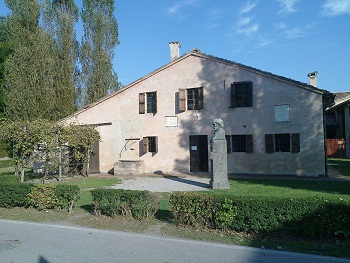
Verdi's childhood home, Le Roncole
Verdi possessed a dominant place in the genre of Italian opera
after the era of Vincenzo Bellini, Gaetano Donizetti, and Gioachino Rossini,
whose works significantly influenced him.
In his early operas, Verdi showed
interest in the Risorgimento movement in pursuit of the unification of Italy,
and as an elected politician, he also participated for a while. The chorus “Va,
pensiero” from his early opera, “Nabucco (1842)” and similar choruses in later
operas reflected the spirit of this Italian unification movement, and Verdi was
respected as a representative of these ideals.
The portrait of Giuseppe Verdi, Giovanni Boldini
However, Verdi, who was a very
private person, after succeeding as an opera composer and being able to reduce
the amount of opera-making work, tried to live an ordinary life by owning the
land in his hometown. However, Verdi, who succeeded in the opera “Aida (1871)”,
returned to the musical world and then with his late three masterpieces, “The
Requiem (1874)” and the operas “Otello (1887)” and “Falstaff (1893)”, he
surprised the musical world.
Verdi conducting the Paris Opera premiere of Aida in 1880
In his last years, Verdi did many
philanthropic ventures, publishing a song in 1894 for the benefit of earthquake
victims in Sicily, and from 1895 planning, building and donating a shelter for
retired musicians in Milan, and building a hospital close to Busseto. While
staying at the Grand Hotel in Milan, Verdi suffered a stroke on January 21,
1901 and died on January 27 at the age of 87.
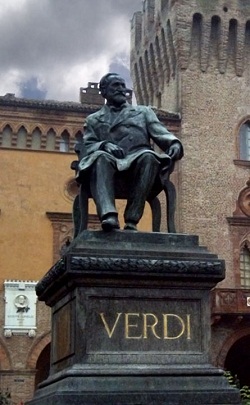
The statue of Verdi, Busseto
His body was initially buried in a
private ceremony at Milan's Cimitero Monumentale and then a month later moved
to the crypt of the Casa di Riposo. At this time, the opera Nabucco's “Va,
pensiero” was conducted by Arturo Toscanini along with a chorus of 820 singers,
and a huge crowd of about 300,000 attended the ceremony.
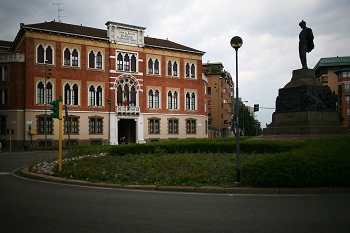
Casa di riposo per musicisti, Milano
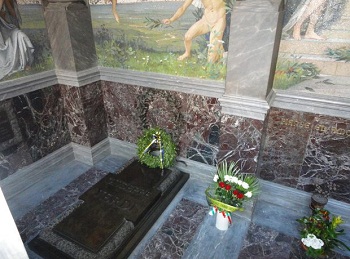
Verdi's grave, the Casa di Riposo, Milan
Today, his opera is still very
popular and the 2013 bicentenary of his birth was widely celebrated in
broadcasts and performances.