Showing posts with label Oil Painting. Show all posts

Monday, December 21, 2020

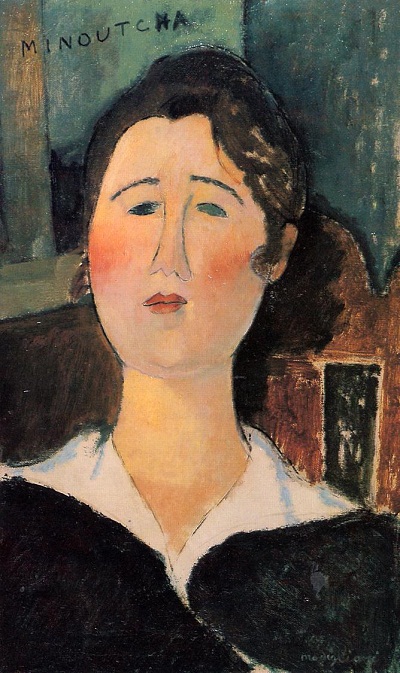
The Works by Amedeo Modigliani: 77. Minoutcha (1917)


How are you?

Modigliani Institute Korea (MIK) is currently introducing artworks of Amedeo Modigliani one by one every week.

The 77th work to introduce for this week is “Minoutcha” in 1917.

This work is an expressionist style portrait and an oil painting on a canvas with the size of 55.3 x 33 cm, and held in private collection.

This work depicts a woman in a chubby style rather than an elongated style, one of Modigliani's distinctive painting styles.

It also adds faint lines to the woman's chin and neck to further emphasize her chubby face. The woman's appearance generally looks round and voluptuous, but her nose shows sculptural traces that Modigliani still had regrets even after stopping his activities.

Based on the viewer's position, comparing to the many other works of Modigliani, having poses that are slightly tilted to the left, the woman in this work has almost a straight pose without inclination.

“MINOUTCHA”, which might be seen as the model’s name in the upper left, and the left background are tilted downward, while the right background has no inclination. Then, the last two letters "HA" of the model's name "MINOUTCHA" are written in bold as if they were misspelled and the correct letters were written on them again.

This work used several colors, but since most of them are dark tones, it feels like monotone and gloomy.

Modigliani treated the woman's neck not very long to support the chubby woman's appearance in this work.

The right background was treated much darker, but instead, it leaves a lot of white spaces including the woman's right hair and such sparse brushworks relieve the darker treatment on the right side compared to the left side and it also seems like an unfinished work.

The woman's eyes show the colors of the background itself as if the background is visible through her eyes, and as a result, the colors of the two eyes are different, which is different from the general style of Modigliani, expressing both eyes without pupils as same color. The woman's eyes do not have pupils, but they are making gloomy and sad feeling, and her blushing face further emphasizes such gloomy feeling.

In addition, the black clothes and white collar worn by the model give a contrast effect each other as well as giving her freshness and stability.

In addition to this work, the examples of other works by Modigliani that he painted models in a chubby style rather than an elongated style are as follows.


Burgundian Woman (1918)


Madame Amédée (Woman with Cigarette)
(1918)


Thank you.


Amazon Author Page

Lecture Program List

YouTube

Korean Blog

Naver TV

Naver Post


Friday, November 1, 2019

The Introduction of the Works by Amedeo Modigliani: 12. Portrait of Jean Alexandre (1909)


How are you?

Modigliani Institute Korea (MIK) is currently introducing artworks of Amedeo Modigliani one by one every week.

The 12th work to introduce this week is “Portrait of Jean Alexandre (1909)”.

This work is, a portrait of an expressionist style and an oil painting on canvas with the size of 65 x 81 cm, painted by Modigliani in 1909.

Jean, the model of the work, was a young student at the time and he commissioned Modigliani for this work.

It is also the work which Modigliani painted after he painted the portraits of Jean’s father and Paul Alexandre, who was his brother as well as the friend and patron of Modigliani.

Modigliani painted this work in his studio at 14, Cite Falguiere at the time.

In this work, Jean is wearing a maroon tie, a white shirt and a black suit, leaning his head on his right hand.

The reason why Modigliani used black color for the suit of Jean is that the black color was the symbol of expensive suits for the wealthy people at the time.

Modigliani also used brown color as the background of the painting to further enhance the richness of Jean.

Modigliani, who was exactly understanding the influence of colors on painting, used a combination of warm and dark colors to highlight the professionalism of Jean, and wanted the viewers to recognize that Jean is from a wealthy family and well educated.

In addition, Modigliani did not place any objects besides the model in this work in order not to fade the meaning of this work.

Jean's face in this work is also an example that Modigliani was influenced by African sculptures.

The right arm of the model rests on a pillar on the wall, but Modigliani did not clearly represent the pillar in the painting.

It seems to be an effort to preserve the meaning of the work with simple backgrounds, and instead Modigliani treated Jean’s body as curves to represent that he is leaning against the pillar.

The model’s placement and the background’s expression of Modigliani is a part showing his excellent artistic techniques.

Jean was not an artists’ patron, but in the spring of 1909, when his brother, Paul Alexandre, left Paris, he replaced Paul's role and encouraged Modigliani and helped his daily life.

A few years later, in June 1913, Jean died of tuberculosis.
However, Modigliani stayed in Italy and did not know this at the time.

He returned to Paris a few days after the funeral of Jean and could not attend his funeral.

Thank you.


The Introduction of the Works by Amedeo Modigliani: 11. The Beggar of Livorno (1909)


How are you?

Modigliani Institute Korea (MIK) is currently introducing artworks of Amedeo Modigliani one by one every week.

The 11th work to introduce this week is “The Beggar of Livorno (1909)”, an oil painting on canvas having a size of 66 cm x 52.7 cm.

This was the only work Modigliani painted in his hometown, Livorno, longing for returning to Paris while staying in Livorno.

In the title of this work, Livorno is sometimes replaced with “Leghorn”, which is the English term for Livorno.

After Modigliani painted this work, he hung it for several months on the wall of his studio in Rue Falguière until it was exhibited at the Salon des Independants in 1910.

In the early years, Modigliani's favorite subjects were portraits of friends and the poor.

The main reason for such model selection was because Modigliani was not able to pay for the model.

But in addition to the issue of model fees, other reason can be found in literary works that have had a great influence on the formation of Modigliani's life values.

Because until just before his death (including when he was able to pay model fees), Modigliani's favorite models were the common and poor people such as children, peasants, and working-class men and women, and he painted mainly the poor throughout his life.

The evidence for this is that the works Modigliani had painted wealthy people are few, except for some of his works including “The Bride and Groom” in 1915.

The year of 1909, when Modigliani painted this work was a time when he was fascinated by Cézanne's work, and Cézanne was one of the most influential artists for an entire generation of painters.

Fascinated by Cézanne's work at the time, Modigliani clearly showed Cézanne's influence in this work along with other work, "The Cellist", which he painted in the same year.

In other words, the structure of the model's face and the intense brush strokes of blue and green colors in particular in this work are reminiscent of Cézanne's style.

It is believed that the reason why Modigliani hung this painting on the wall of his studio for several months before the exhibition was to pay respects to Cézanne as well as the preciousness of this work.

Thank you.


“The Hay Wain” by John Constable: A Musical Journey Through an English Summer | J Music

Melodies on Canvas – A Journey Through Art & Sound | Episode 25 What does a beautiful landscape painting sound like? Can the peacefu...