Showing posts with label Expressionism. Show all posts

Monday, June 14, 2021

The Works by Amedeo Modigliani: 90. The Zouave (1918)


How are you?

Modigliani Institute Korea (MIK) is currently introducing artworks of Amedeo Modigliani.

The 90th work to introduce for this week is “The Zouave” in 1918.

This work is an expressionist style portrait and an oil painting on canvas with the size of 63 x 48 cm and possessed in private collection.

The Zouaves were a class of light infantry regiments of the French Army that served from 1830 to 1962 in then-French-controlled North Africa. Originally, the zouaves were a regiment of Berber volunteers from the Zwawa group of tribes in Algeria, who had gained a reputation for fighting for local rulers under the Ottoman Empire, and the French word zouave is derived from the name of the Zwawa Berber. 


French zouave (c. 1870)


The regiment was to consist of Zwawa Berbers, French non-commissioned officers and French officers, and the distinctive uniform of the zouave unit originated in North Africa. Initially recruited only from the Berber tribes, the zouave corps was formed by the French over time, but the North African uniform was retained.


Zouaves at the Battle of Zaatcha during the Conquest of
Algeria


This work was painted by Modigliani in Nice in 1918, and it is evident that the model for this painting was a soldier of the zouave who was on vacation there at the time. He is wearing the mustard-colored uniform and calotte worn by African Army soldiers, and on the calotte there are the crescent moon and the figure three representing his regiment. The exact identity of the model, other than being a zouave soldier, is unknown, but the model offers Modigliani an opportunity for his colorist study.

Given that the model is wearing a thick uniform, this painting appears to have been painted in winter, and the model's soft face with no particular personality feels very different from the distinctly defined expressions of the models in Modigliani’s other portraits.

In addition, the military decoration on the chest of the model serves to soften the monotony of the mustard-colored uniform.

Besides Modigliani, Vincent van Gogh also painted soldiers in zouave uniform.


Portrait of Milliet, Second Lieutnant of the
Zouaves, Vincent van Gogh (1888)


Zouave, Vincent van Gogh (1888)


Thank you.


Amazon Author Page

Lecture Program List

YouTube

Korean Blog

Naver TV


Sunday, May 2, 2021

The Works by Amedeo Modigliani: 87. Little Girl in Black Apron (1918)


How are you?

Modigliani Institute Korea (MIK) is currently introducing artworks of Amedeo Modigliani.

The 87th work to introduce for this week is “Little Girl in Black Apron” in 1918.

This work is an expressionist style portrait and an oil painting on canvas with the size of 92.5 x 60.5 cm and housed in the Kunstmuseum Basel in Basel, Switzerland.


Kunstmuseum Basel, Basel, Switzerland


Modigliani's 1918 paintings appear a series of children, which is no coincidence. The reason for this is that during Modigliani's stay in southern France, there were neither portrait commissions nor the models such as Zborowski had paid in Paris. As a result, Modigliani was free to choose the subject for his paintings, whether as adults or children. 


Portrait of Leopold Zborowski, Amedeo
Modigliani (1917)


Examples of paintings for adults at the time include “Seated man with a cane” and “A beautiful grocer”. Modigliani, who spent his childhood amid families with many children in his hometown of Livorno, may have recalled his childhood, painting innocent children. 


Seated Man with a Cane, Amedeo Modigliani
(1918)


A Beautiful Grocer, Amedeo Modigliani
(1918)


In this painting, the pose of the little girl with big eyes looks a little stiff and awkward, but in another painting of the same little girl, “Two little girls,” she looks more comfortable. 


Two Little Girls, Amedeo Modigliani (1918)


The little girl's black outfit stands out with some embroidery at the bust, and her black apron and the chest of drawers serve to add horizontal lines to the paintings. Also, the black book on the drawers suggests that the little girl is a wise and studious child.


Thank you.


Amazon Author Page

Lecture Program List

YouTube

Korean Blog

Naver TV

Naver Post


Sunday, April 18, 2021

The Works by Amedeo Modigliani: 86. Little Girl in Blue (1918)


How are you?

Modigliani Institute Korea (MIK) is currently introducing artworks of Amedeo Modigliani.

The 86th work to introduce for this week is “Little Girl in Blue” in 1918.

This work is an expressionist style portrait and an oil painting on canvas with the size of 116 x 73 cm.

This painting has a large size, although Modigliani generally used a large canvas only when drawing adult models: for example, the portraits of Leopold Zborowski (107 x 66 cm) and Mario Varvogli (116 x 73 cm)


Portrait of Leopold Zborowski, Amedeo
Modigliani (1917)


Portrait of Mario Varvogli, Amedeo
Modigliani (c.1919)


The collection of the Barnes Foundation such as “Redheaded Girl in Evening Dress (116.2 x 73 cm)” and “Young Woman in Blue (90.8 x 60 cm)” were also painted on a large size canvas.


Redheaded Girl in Evening Dress, Amedeo
Modigliani, The Barnes Foundation (1918)


Young Woman in Blue, Amedeo
Modigliani, The Barnes Foundation (1919)


The Collection, Barnes Foundation


This painting shows a young girl of 8-10 years old, standing in the corner of a room and is drawn almost life-size. The blue color of the girl's dress and walls goes well with the girl's eyes and the large wrinkled collar on her clothes. The composition based on the corner of the room combines with the girl's shadow and the dark tiles on the floor to give a sense of depth and stability, and the girl's boots and the dark color of her hair are in good harmony with the red ribbon on her head. 

This painting was created in Nice, Southern France, and seems to have been painted on a warm, sunny day in the bright shades of pastel blue and the girl's shadow on the floor and walls.


Amedeo Modigliani (right) in Nice (1918)


It is very rare for Modigliani to paint the floor in his paintings, and in this painting it seems that he painted the floor to emphasize the girl standing in the corner of the room. In this painting, the floor is tilted up and her feet are facing down, giving the feeling of the girl floating in the air.

The girl's expression has sweetness and innocence, but rather it gives a feeling of gloomy rather than joy. It also seems that she comes from a poor family in the girl's expression, and maybe the dress the girl is wearing is the only dress she has.


Thank you.


Amazon Author Page

Lecture Program List

YouTube

Korean Blog

Naver TV

Kakao TV

Naver Post


Monday, December 28, 2020

The Works by Amedeo Modigliani: 78. Portrait of a Woman in a Black Tie (1917)


How are you?

Modigliani Institute Korea (MIK) is currently introducing artworks of Amedeo Modigliani one by one every week.

The 78th work to introduce for this week is “Portrait of a Woman in a Black Tie” in 1917.

This work is an expressionist style portrait and an oil painting on a canvas with the size of 65.4 x 50.5 cm, and held in private collection.

Painted in 1917, this work gives the impression that Modigliani went straight to the point intending to convey to viewers, by completely eliminating extraneous elements. However, it is surprising that the characteristics and personality of the model are conveyed to the viewers as it is, despite the almost complete elimination of such elements. 

This style of Modigliani can be seen as a good representation of his character for pursuing the purity of art, and his friend Max Jacob said, "To Modigliani, everything in art had to lead to purity. Everything in this painting is just the expression of his absolute demand for crystalline purity.”


Max Jacob, Amedeo Modigliani


It is said that the prototype of this portrait was his lover, a journalist Beatrice Hastings. Hastings was a woman Modigliani met for about two years before meeting Jeanne Hébuterne, and his muse who gave Modigliani a lot of artistic inspiration. Some documents said that she was a legendary woman who tamed Modigliani, an arrogant artist, as a docile person.


Portrait of Beatrice Hastings, Amedeo
Modigliani


The woman in this work is depicted in almost every unique style of Modigliani: a mask-like face, almond-shaped eyes without pupils, triangular nose, small mouth, arched eyebrows, slanted head and elongated face.

However, one of his features, an elongated neck, does not appear in this work, and the woman's neck, covered with the collar of her white shirt, is barely visible. Although the woman in this work is depicted in almost every unique style of Modigliani, unlike the women in his other works, she looks very mysterious and strange, and at the same time exudes a unique and elegant charm that only women have.

She also should be a happy woman when referring to her attire, but her actual appearance indicates that she is not happy but looks gloomy, and the background color further enhances her gloomy look. 

It can be said that receiving this feeling from the woman without pupils is a manifestation of Modigliani's genius talent for expressing his models’ characteristics and personality in his paintings.


Thank you.


Amazon Author Page

Lecture Program List

YouTube

Korean Blog

Naver TV

Naver Post


Monday, December 21, 2020

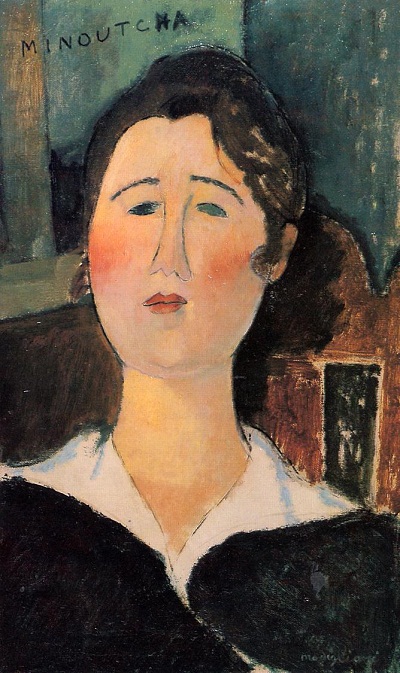
The Works by Amedeo Modigliani: 77. Minoutcha (1917)


How are you?

Modigliani Institute Korea (MIK) is currently introducing artworks of Amedeo Modigliani one by one every week.

The 77th work to introduce for this week is “Minoutcha” in 1917.

This work is an expressionist style portrait and an oil painting on a canvas with the size of 55.3 x 33 cm, and held in private collection.

This work depicts a woman in a chubby style rather than an elongated style, one of Modigliani's distinctive painting styles.

It also adds faint lines to the woman's chin and neck to further emphasize her chubby face. The woman's appearance generally looks round and voluptuous, but her nose shows sculptural traces that Modigliani still had regrets even after stopping his activities.

Based on the viewer's position, comparing to the many other works of Modigliani, having poses that are slightly tilted to the left, the woman in this work has almost a straight pose without inclination.

MINOUTCHA”, which might be seen as the model’s name in the upper left, and the left background are tilted downward, while the right background has no inclination. Then, the last two letters "HA" of the model's name "MINOUTCHA" are written in bold as if they were misspelled and the correct letters were written on them again.

This work used several colors, but since most of them are dark tones, it feels like monotone and gloomy.

Modigliani treated the woman's neck not very long to support the chubby woman's appearance in this work.

The right background was treated much darker, but instead, it leaves a lot of white spaces including the woman's right hair and such sparse brushworks relieve the darker treatment on the right side compared to the left side and it also seems like an unfinished work.

The woman's eyes show the colors of the background itself as if the background is visible through her eyes, and as a result, the colors of the two eyes are different, which is different from the general style of Modigliani, expressing both eyes without pupils as same color. The woman's eyes do not have pupils, but they are making gloomy and sad feeling, and her blushing face further emphasizes such gloomy feeling.

In addition, the black clothes and white collar worn by the model give a contrast effect each other as well as giving her freshness and stability.

In addition to this work, the examples of other works by Modigliani that he painted models in a chubby style rather than an elongated style are as follows.


Burgundian Woman (1918)


Madame Amédée (Woman with Cigarette)
(1918)


Thank you.


Amazon Author Page

Lecture Program List

YouTube

Korean Blog

Naver TV

Naver Post


After the Film Ends, What Remains? — “After the Last Summer”

What remains after a film ends? For some people, it may be a particular scene. For others, a line of dialogue, a character, or simply a fe...