Author & Music Composer | Lecturer | Broadcaster | Cultural Arts Expert |
President of Art Collage JANG, J Music, J Art, and J Books & Media. | Author of 40+ books on Amazon, including “The Crimson Horror Series” and “The Great and Immortal Painters’ Stories Series.” |
Exploring the worlds of art, music, literature, and culture through writing, composition, education, and creative media. |
Creating stories. Composing music. Celebrating the arts.
Influenced on:
Leonardo da Vinci, Pietro Perugino, Lorenzo di Credi, Domenico Ghirlandaio,
Francesco Botticini
Teachers:
Donatello, Filippo Lippi
Pupils:
Leonardo da Vinci, Pietro Perugino, Lorenzo di Credi
Andrea
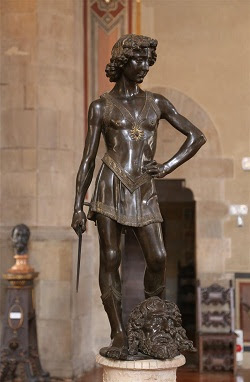
del Verrocchio was an Italian painter, sculptor and goldsmith, born circa 1435
and died in 1488.
Portrait of Verrocchio, Nicolas de Larmessin
He is presumed to be known as Verrocchio after the surname of
his master, a goldsmith.
A Goldsmith in His Shop, Petrus Christus
There are few works that are clearly attributed to
him, but many famous painters were trained at his workshop, including Leonardo
da Vinci, Pietro Perugino and Lorenzo di Credi. His greatest importance was his
activities as a sculptor, and his last work, the statue of Bartolomeo Colleoni
in Venice, is considered a masterpiece.
Modigliani Institute Korea (MIK) is
currently introducing artworks of Amedeo Modigliani one by one every week.
The 34th work to introduce for this
week is “Bride and Groom (1915)”.
This work is a portrait of an
expressionist style and an oil painting on canvas with the size of 55.2 x 46.4
cm.
It is currently owned by the Museum
of Modern Art (MoMA) in New York City, USA.
This work has various titles such
as "The Newlyweds" and "The Couple".
Most of Modigliani's works are
portraits of individuals, but this work, which he painted a couple, is one of
the most unusual and rare works.
Modigliani also painted most of his
works using the poor as models, but it is also exceptional to depict rich
people.
In this work, the man can be
imagined as a rich man in his cool and expensive dress, and the woman’s dress
cannot be seen, but it is easily imagined that she also may be wearing a cool
and expensive dress that matches the groom's level.
This work is a good example showing
some of Modigliani's unique work styles.
In other words, the elongated face
and neck of the model are such examples, and the models’ small mouth, pointed
nose and empty eyes without pupils also show the typical style of Modigliani
influenced by African masks and sculptures.
The woman in this work also shows
the aesthetic ideal that Modigliani pursues: dark hair and pale skin.
There are only two works, which
Modigliani, who specialized in a single figure, depicted a couple.
They are the “Bride and Groom” and
a year later, in 1916, “Jacques and Berthe Lipchitz”. For that reason, this work is often
compared with “Jacques and Berthe Lipchitz”.
However, if the two works are
compared, this work is much more faithful to African masks and sculptures, while
the portrait of Jacques Lipchitz couple is much softer and more curved.
The actual character of this work
is unknown, but it is likely that they are acquaintances of Modigliani, as the
figures of his other portraits. However, Modigliani met a variety
of people while living in Paris, so they might be a couple whom Modigliani
doesn't know at all.
Jean Cocteau once said that this
work might be inspired by the upstarts whom Modigliani accidentally discovered
on the road.
This work also reveals the
influence of Cubism, which Modigliani was influenced, in many parts.
For the background, it looks as if
the puzzle pieces have been put together, by systematically separating it into
vertical and horizontal lines.
In addition, Modigliani divided the
canvas in half, and strictly confined the man and woman in each half of the
space and painted.
In each half of the canvas, a
vertical line was drawn at the center of the man and woman, respectively, and
the characteristics of the model were constructed around this vertical line.
In other words, to balance the right-sided
nose and hat and the larger ear, Modigliani painted the left-sided beard and
bow tie for the man and the left part of the dress darker.
For the woman, Modigliani painted
the larger amount of hair by drawing the left side of her head higher and
larger and the left-sided mouth to balance the right-sided nose, the earring on
one side, and the shoulder on the right side.
Modigliani also emphasized the
difference in height between the man and woman by using different background
expression.
In other words, Modigliani used
complex vertical and horizontal lines in the woman’s background while he did
not express a specific background for the man.
In this work, the man and woman
show opposite appearances: the man is tall and old, but the woman is small and
young. Therefore, the two don't look like
a couple.
Perhaps the reason why Modigliani,
who mainly painted the poor, drew the rich couple might be to maximizeridicule
and resentment against the rich by contrasting the unsuitable man and woman
under the title, The Couple.
Perhaps Modigliani might express
despise and ridicule for the rich who think of love easily by using the title,
The Couple, ironically for the man and woman who seem to be immoral.
This work borrowed some styles of
Cubism, but Modigliani still tries to stick to his subject of interest; human
body and face.