Showing posts with label Beatrice Hastings. Show all posts

Monday, December 28, 2020

The Works by Amedeo Modigliani: 78. Portrait of a Woman in a Black Tie (1917)


How are you?

Modigliani Institute Korea (MIK) is currently introducing artworks of Amedeo Modigliani one by one every week.

The 78th work to introduce for this week is “Portrait of a Woman in a Black Tie” in 1917.

This work is an expressionist style portrait and an oil painting on a canvas with the size of 65.4 x 50.5 cm, and held in private collection.

Painted in 1917, this work gives the impression that Modigliani went straight to the point intending to convey to viewers, by completely eliminating extraneous elements. However, it is surprising that the characteristics and personality of the model are conveyed to the viewers as it is, despite the almost complete elimination of such elements. 

This style of Modigliani can be seen as a good representation of his character for pursuing the purity of art, and his friend Max Jacob said, "To Modigliani, everything in art had to lead to purity. Everything in this painting is just the expression of his absolute demand for crystalline purity.”


Max Jacob, Amedeo Modigliani


It is said that the prototype of this portrait was his lover, a journalist Beatrice Hastings. Hastings was a woman Modigliani met for about two years before meeting Jeanne Hébuterne, and his muse who gave Modigliani a lot of artistic inspiration. Some documents said that she was a legendary woman who tamed Modigliani, an arrogant artist, as a docile person.


Portrait of Beatrice Hastings, Amedeo
Modigliani


The woman in this work is depicted in almost every unique style of Modigliani: a mask-like face, almond-shaped eyes without pupils, triangular nose, small mouth, arched eyebrows, slanted head and elongated face.

However, one of his features, an elongated neck, does not appear in this work, and the woman's neck, covered with the collar of her white shirt, is barely visible. Although the woman in this work is depicted in almost every unique style of Modigliani, unlike the women in his other works, she looks very mysterious and strange, and at the same time exudes a unique and elegant charm that only women have.

She also should be a happy woman when referring to her attire, but her actual appearance indicates that she is not happy but looks gloomy, and the background color further enhances her gloomy look. 

It can be said that receiving this feeling from the woman without pupils is a manifestation of Modigliani's genius talent for expressing his models’ characteristics and personality in his paintings.


Thank you.


Amazon Author Page

Lecture Program List

YouTube

Korean Blog

Naver TV

Naver Post


Friday, June 19, 2020

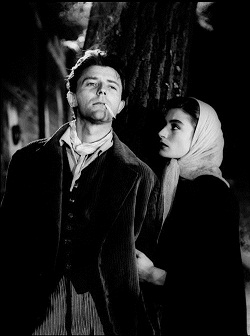
The Stories about Art Films: 10. Les Amants de Montparnasse (1958), ACJ Movie Academy

Basic Info

Title: Les Amants de Montparnasse
Genre: Drama
Country: France, Italy
Language: French
Running time: 108 minutes
Release date: 4 April 1958

Staff

Director: Jacques Becker
Producer: Sandro Pallavicini
Screenplay: Jacques Becker, Henri Jeanson
Music: Paul Misraki
Cinematography: Christian Matras
Editor: Marguerite Renoir

Cast

Gérard Philipe as Amedeo Modigliani
Lilli Palmer as Beatrice Hastings
Anouk Aimée as Jeanne Hébuterne
Lea Padovani as Rosalie
Lino Ventura as Morel
Gérard Séty as Léopold Zborowski
Lila Kedrova as Anna Zborowska
Marianne Oswald as Berthe Weill

Summary


“Les Amants de Montparnasse” is a 1958 French-Italian drama film partially based on the last years of the life of Italian artist Amedeo Modigliani, who died while working in poverty in Montparnasse, Paris. Some of the most famous paintings by Modigliani at the time were the paintings of Beatrice Hastings and Jeanne Hébuterne, his last two lovers appeared in the movie.

Plot


The artist, Modigliani, known as Modi, who is a leading figure of the bohemians in Paris, paints while drinking and living with the charming writer Beatrice, but rarely sells his paintings. He meets a young and beautiful art student named Jeanne. However, Jeanne is locked up by her family, who prevents her from meeting Modigliani. His friends, the Zborowskis, do their best to make Modigliani famous, and send him to Nice to recover his health, which was weakened by constant alcohol and tobacco. Meanwhile, Jeanne, who has been locked up, flees and goes to Modigliani in Nice, after which the two become inseparable.
The Zborowskis, who returned to Paris, organize Modigliani's solo exhibition at the famous gallery of Madame Weill’s, where those who came to the opening have free drinks but nobody buys his paintings. Also, the police, who were dissatisfied with the exhibition, order the removal of a nude on the window. A cynical dealer Morel says that Modi will soon die, and people then will buy his paintings. The Zborowskis meet an American millionaire who is interested in Modi's paintings, but he says he will use Jeanne's blue eyes for advertising his products, and Modigliani is disgusted at his saying.
Discouraged by the inability to combine the beauty contained in his paintings of Beatrice and Jeanne with commercial reality, Modigliani tries to sell his paintings going round cafés, but ends in vain. Collapsing in the street, Modigliani is taken to a hospital, where he dies alone. Without telling what happened, the dealer Morel rushes to Jeanne and immediately buys all the unsold paintings of Modigliani for cash.

Movie Review


“A genius called Modi who died poor, sad and neglected!!!”
“Good film, tragic end”

Interesting stories about the film


1. Originally, Max Ophüls was the director of the film, but he died soon afterwards and was replaced by Jacques Becker.
2. Italian actress Lea Padovani was dubbed by the voices of French actress Nadine Alari in some scenes, and her own voice with strong Italian accents can be heard in others.
3. German actress Lilli Palmer's voice was not dubbed in the film, which was very rare in French films at the time.

Thank you.


Sunday, May 3, 2020

The Introduction of the Works by Amedeo Modigliani: 44. Beatrice Hastings in front of a door (1915)


How are you?

Modigliani Institute Korea (MIK) is currently introducing artworks of Amedeo Modigliani one by one every week.

Amedeo Modigliani

The 44th work to introduce for this week is “Beatrice Hastings in front of a door”.

This work is a portrait of an expressionist style and an oil painting on canvas with the size of 81.3 x 46.4 cm, and currently in private collection.

Beatrice Hastings, an English writer and poet, met Modigliani in 1914 by the introduction of the sculptor Ossip Zadkine. Modigliani then lived with her in her house for two years until 1916. She became famous for her peculiar behavior, attire, and avid supporter for the theories of Helena Blavatsky.

Beatrice Hastings

Ossip Zadkine

Helena Blavatsky was a Russian occultist, philosopher, and author, who was born on August 12, 1831 and died on May 8, 1891. She co-founded the Theosophical Society in the United States in 1875. The goal of the Theosophical Society was to become a nucleus of the universal brotherhood of humanity, without distinction of race, gender, class, and skin color.

Helena Blavatsky

Hastings' influence on Modigliani is divided. Some say she made Modigliani more and more addicted to drug and alcoholism, but it is certain that while she was with Modigliani, she was his muse, who gave him a lot of artistic inspiration.

Modigliani painted some paintings of Hastings. However, the appearances of the paintings are not the same, and her appearances are changing according to the paintings. For this work, she looks like a graceful lady wearing a feathered hat. Looking at the image of the work, she looks like a strong and cool-hearted woman, and her tight mouth shows her stubborn personality. It is also interesting to note that the shapes of her nose and neck are similar and that one of her ears is significantly emphasized compared to the other. The background consists of a plane dominated by straight lines using an object of a door. The background of these straight lines makes her curved face and elongated neck more prominent.

Although Hastings was very bohemian, in this picture, she is a graceful and an elegant lady wearing feathered hat, such as “Madame Pompadour,” one of the paintings that Modigliani painted her. Such appearance of her seems to reflect the situation that most women preferred to wear hats in public places at the time.

Madame Pompadour

Thank you.


Monday, April 6, 2020

The Introduction of the Works by Amedeo Modigliani: 40. Portrait of Paul Guillaume (Novo Pilota) (1915)


How are you?

Modigliani Institute Korea (MIK) is currently introducing artworks of Amedeo Modigliani one by one every week.

The 40th work to introduce for this week is “Portrait of Paul Guillaume (Novo Pilota) (1915)”.

This work is a portrait of an expressionist style and an oil painting on cardboard with the size of 105 x 75 cm. Currently, this work is owned by the Musée de l'Orangerie in Paris, France.

This work is a portrait of Paul Guillaume, who was his friend and art dealer, painted by Modigliani in 1915,

Modigliani painted this work at 13 Rue Norvins, where Beatrice Hastings lived. Modigliani lived there with her at the time and before her, Emil Zola lived.

Paul Guillaume, who was introduced to Modigliani by Max Jacob in 1914, became the only buyer of Modigliani's work from 1915 to 1916 and his first real dealer.

Paul Guillaume appeared Parisian art scene in 1914, when he opened his first gallery on the rue de Mirosmesnil. Guillaume, who determined to escape from the background of his poor family he was born at all cost, studied art at the Montmartre cafés and began his art career by collecting Picasso's works and African statues, and later became an expert especially on African statues.

One day, the owner of the garage, where Guillaume worked to make his living, allowed him to display one of his African statues in the garage window. At this time, the sculpture displayed in the window was noticed by Apollinaire, who was a writer and an art critic, and thus Guillaume thereafter was able to begin the life of art dealing and research as full-time job. Thanks to Apollinaire, Max Jacob and Waldemar George, Guillaume was able to expand his business, the art dealing, and even maintained it during World War I.

For Modigliani, in an open letter to Francis Carco, Guillaume wrote "When Max Jacob introduced Modigliani to me in 1914, he was a sculptor who drew painting. Rightly or wrongly I felt responsibility to urge Modigliani to paint rather than sculpture."

Unfortunately, Guillaume died at the young age of 43, and a lot of suspicions especially related to his wife, Domenica, were raised for his questionable death, and his wife was once accused of the murder of Paul Guillaume. After Guillaume's death, Domenica, who married French architect Jean Walter, decided to donate her ex-husband Guillaume's collection to the French government, and since she died, Musée de l'Orangerie possessed many pieces of his collection

This work is characterized by containing many texts and symbols.

First of all, “A Star of David” symbol and the text “STELLA MARIS” are displayed on the upper right of the work, and his signature “MODIGLIANI”, the “swastika” symbol in the shape of a broken cross and the year “1915” when Modigliani painted this work are displayed on the lower right.

upper right

lower right

In addition, the text “PAUL GUILLAUME” is written at the top left and the text “NOVO PILOTA” is written at the bottom left with two lines ending “arrow”.

top left

bottom left

Let's summarize the meaning of these texts and symbols that Modigliani used in this work.

First, the Star of David is commonly used as a symbol of modern Jewish identity and Judaism.

Second, the Latin “Stella Maris,” which translates into “star of the sea,” is one of the titles referring to the Virgin Mary, the mother of Jesus Christ.

Third, “swastika” is a broken cross-shaped “卐” or “卍”, a geometrical figure and an ancient religious icon in the Eurasian cultures, and used as a symbol of divinity and spirituality in Indian religions, including Hinduism, Buddhism and Jainism. Swastika was also used as a symbol of the German Nazis, but when Modigliani used this symbol in this painting, the Nazis did not exist. Therefore, it is simply an ancient Sanskrit’s symbol.

Fourth, “NOVO PILOTA” means “new pilot”.

Perhaps these texts and symbols seem to be intended to express a sincere appreciation of Modigliani to Paul Guillaume, who became working with him as his dealer, as well as implicitly to express his Jewish origin.

Then, this work could be included as one of the few that Modigliani expressed his Jewish identity in his works.

Thank you.


Sunday, February 16, 2020

The Introduction of the Works by Amedeo Modigliani: 33. Beatrice Hastings, Seated (1915)


How are you?

Modigliani Institute Korea (MIK) is currently introducing artworks of Amedeo Modigliani one by one every week.

The 33rd work to introduce for this week is “Beatrice Hastings, Seated (1915)”.

This work is a portrait of an expressionist style and an oil painting on canvas with the size of 73.5 x 49.5 cm.

This work is one of many paintings for modeling Beatrice Hastings by Modigliani.

A columnist for the British weekly magazine, “New Age”, she came to Paris as a correspondent in Paris in 1914 and met Modigliani.

Hastings was also a woman who was controversial because of her unusual attire and behavior.

Modigliani and Hastings were lovers for two years, sharing alcohol and drugs, constantly fighting, and arguing.

Modigliani was a genius artistic, talented painter who was famous for wonderfully expressing the characters or personalities of the models in his paintings.

However, this work is unique in that it is painted so that the character or personality of Hastings is not recognized at all.

Painted as simple as if it feels lacking in expressiveness, it seems like this work shows the reappearance of Modigliani's regret for the sculpture.

Elongated neck, oval head, curved and simple contours, everything evokes a sculptural style, especially very similar to the Caryatid style.

There is also no background decoration except Hastings' chair and the chair is rounded to match the curved and rounded model.

Hastings' eyes are drawn without pupils, giving the impression of seeing the background through the eyes.

The model's face and neck were tilted to the right for a balanced composition against the model, who is sitting biased to the left, throughout the canvas.

In addition, Hastings' face and her body including her wrapped arms are in oval form, and it feels like small and large ovals are symmetrically attached.

For the colors used, Modigliani used red and warm colors throughout the work, which make Hastings' shadow look like black smoke from behind her.

Thank you.


Sunday, February 9, 2020

The Introduction of the Works by Amedeo Modigliani: 32. Beatrice Hastings (1915)


How are you?

Modigliani Institute Korea (MIK) is currently introducing artworks of Amedeo Modigliani one by one every week.

The 32nd work to introduce for this week is “Beatrice Hastings (1915)”.

This work is a portrait of an expressionist style and an oil painting on cardboard with the size of 43 x 35 cm.

It is currently owned by “Museo del Novecento” in Milan, Italy.

This work is one of many paintings for modeling Beatrice Hastings by Modigliani, which is characterized by the appearance of Hastings, remote from the depiction by her colleagues or her depiction in her own memoirs.

A columnist for the British weekly magazine, “New Age”, she came to Paris as a correspondent in Paris in 1914 and met Modigliani.

Hastings was also a woman who was controversial because of her unusual attire and behavior.

Modigliani gave up his sculptures devoted to several years and returned to painting in 1914.

This work was influenced by the Cubism that Modigliani was interested in at the time.

Modigliani, who was fascinated by Cézanne from around 1907 after moving to Paris in 1906, was in the process of completely overcoming Cézanne's influence and moving on to his own art style.

In this work, Hastings has a round but angular face, small mouth, thin eyebrows, small, pierced eyes, and high positioned big ears, with some elements of Cubism.

In addition, the green color used in the work contrasts with the complexion close to ocher color.

Although this is a finished work, it feels as if it is an unfinished work with rough brushstrokes that seem to leave empty spaces in places.

Hastings was thirty-six years old at the time of painting, but Modigliani generally portrayed her as a very soft, doll-like face.

There are also some peculiarities in this work.

First, in addition to the signature "modigliani" in the top right, there are letters on the bottom right that are hard to read by the naked eye, which may be the name of the person to whom Modigliani dedicated this work.

Second, when we look at the photographs of the works by time, we can see that the green areas gradually disappeared over time, which is probably the result of the restoration work.

Finally, the work has holes in the corners and some of them were filled during the restoration.

In Hastings' memoirs, the place where Modigliani and Hastings met was the Chez Rosalie restaurant run by Rosalie Tobia.

Rosalie, the owner of the restaurant, provided food to the poor Modigliani free of charge and Modigliani gave her his paintings in return.

However, Rosalie, who didn't know art well, did not recognize the value of Modigliani’s paintings.

Therefore, many works have been damaged due to her neglected management, such as nailing them on the toilet.

Perhaps the holes in the corners of this work are such nail holes.

Then, this may be one of Modigliani's paintings for Rosalie in return for a free meal.

Thank you.


“Where Love Meets Longing” – A Romantic Cinematic Instrumental Inspired by “Brooklyn” (2015)

Some films remain in our hearts long after their final scenes. Their characters, emotions, and beautiful stories continue to live in our mem...