Author, Lecturer, Broadcaster & Cultural Arts Expert;
President of Art Collage JANG/J Music/J Art/J Books & Media.
Author of over 40 books published on Amazon, including The Crimson Horror series and The Great and Immortal Painters’ Stories series.
Dedicated to sharing insights into art, culture, literature, and creative expression through writing, lectures, media, and content creation.
Produced by: Pierre-Olivier Bardet, Frederick
Wiseman
Screenplay:Frederick Wiseman
Cinematography:
John Davey
Edited
by: Frederick Wiseman
Summary
“National Gallery” is a
documentary film made by Frederick Wiseman that introduces the National Gallery
in London, one of the most comprehensive and most visited picture galleries in
the world. The film was nominated for the César in the category Best
Documentary in 2015.
The main entrance of the National Gallery from Trafalgar Square
This week's
lecture is “George Frideric Handel”, the 5th topic of “Classical Music”, which is a summary of the contents of “90.
Classical Music: 5. George Frideric Handel”introduced
on June 3rd, 2017.
George
Frideric Handel was a German-born composer who was born on February 23, 1685
and died on April 14, 1759. Along with Johann Sebastian Bach, he is a composer
representing the Baroque era.
Handel, Balthasar Denner (1733)
Educated in music in his hometown Halle, Handel
worked as a composer in Hamburg and Italy, and then settled in London in 1712,
where he spent most of his career and naturalized to England in 1727. He was
strongly influenced both by the middle-German polyphonic choral tradition and
by composers of the Italian Baroque.
Having achieved success with the oratorio
“Messiah”, Handel no longer composed Italian operas. His works, "Water
Music" and "Music for the Royal Fireworks" are steadfastly
gaining popularity.
The Great Music Hall in Fishamble Street, Dublin, where Messiah was first performed
The “Water Music” is a collection of orchestral movements,
often published as three suites. It was composed at the request of King George
I of England for a concert on the River Thames and premiered on July 17, 1717.
Handel (left) and King George I on the River Thames, 17 July 1717, Edouard Hamman
“Music for the Royal Fireworks” is a suite for wind instruments composed by
Handel at the request of George II of England for the fireworks scheduled to be
held at Green Park in London on April 27, 1749.
Green Park, London
Unlike other musicians, Handel,
who is optimistic and free-minded, has accumulated a lot of wealth because of
his entrepreneurial skills, but he has lived a life of twists and turns, with
repeated failures. Almost
blind, he died in 1759, and his funeral was held at Westminster Abbey.
Handel's monument, Westminster Abbey
Handel
composed more than forty operas for over thirty years. Since the late 1960s,
interest in Handel's music has grown, and his music exerted a strong influence
on Classical-era composers, including Mozart and Beethoven.
A carved marble statue of Handel, Louis-François Roubiliac, Victoria and Albert Museum, London (1738)
Influenced
by:Antoine Watteau, Horace Vernet, Jacob van
Ruisdael
Influenced
on:Alfred Sisley, Claude Monet, Camille Corot
Joseph Mallord William Turner,
known as William Turner, was an English Romantic painter, printmaker and
watercolorist, who was born on April 23, 1775, and died on December 19, 1851.
He is renowned for his expressive colorizations, imaginative landscapes and
turbulent marine paintings.
Turner was born in a modest class
family in London, where he lived all his life. A child prodigy, Turner entered the
Royal Academy of Arts in 1789 when he was 14 years old, where he exhibited his
first work at the age of 15. He opened his own gallery in 1804 and became a
professor at the academy in 1807, where he lectured until 1828.
Turner, who was very private,
unique, and exclusive, was a controversial figure throughout his career. He
never married but had two daughters named Eveline and Georgiana, between his
housekeeper Sarah Danby. He became more pessimistic and demanding as he got
older, especially after his father died.
Turner, who had been in poor health
since 1845, died in London in 1851, and his body was buried in Saint Paul's
Cathedral, London.
He left behind over 550 oil paintings, 2,000 watercolors and
30,000 artworks on paper.
On every Thursday, I am introducing
the stories about various artists and their paintings with the title
“Interesting Art Stories”.
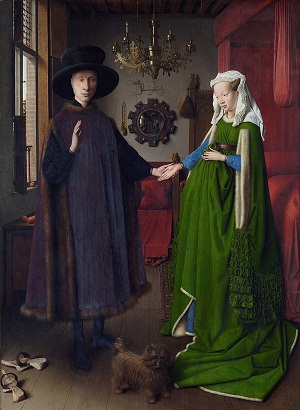
The 11th story for this week is "The Arnolfini Portrait" by a Dutch painter Jan van Eyck.
Jan van Eyck
The Arnolfini Portrait, also known as the "The Arnolfini Wedding” or "The Portrait of Giovanni Arnolfini and his Wife", is an oil painting by the Dutch painter Jan van Eyck in 1434. It is a full-length double portrait, depicting the Italian merchant Giovanni di Nicolao Arnolfini and his wife, and the place of the painting is presumed to be their residence at the Flemish city of Bruges.
Portrait of Giovanni di Nicolao Arnolfini, Jan van Eyck
The placement of the husband and wife in the painting shows the traditional notions of the 15th century about marriage and gender roles. In other words, the woman stands near the bed as a symbol of her role of taking care of the family, while Arnolfini stands near the open window to symbolize his role of working outside for his family. Arnolfini looks at the viewers who see the painting, but his wife obediently gazes at her husband. His hand vertically raised represents his authority, while his wife's hand is in a lower, horizontal and more submissive pose. However, her gaze at her husband indicates that she is equal to her husband, as she does not look down on the floor like a lower class woman.
It is also a controversial painting among experts with some believing the painting depicts a marriage scene and others saying it is a commemoration of a couple’s marriage painted in memory of the deceased wife. This painting shows that the woman is shown with a visible bulge, but the consensus is that the woman in the painting is not pregnant but the meaning of suggesting fertility.
The mirror at the back of the room reflects two figures who seem to be standing in the position of the viewer, one of whom is said to be van Eyck himself. Also, the small medallions in the frame of the mirror show the scenes from the Passion of Christ and may represent an expression of God's promise of salvation for those reflected on the mirror. Also, the mirror itself may represent the eye of God watching the vows of the wedding, and the spotless mirror is a symbol of the purity of the Virgin Mary.
Mirror
The little dog in the painting can be seen as a symbol of fidelity and loyalty, or as a symbol of a couple's desire to have a child.
The woman's green dress symbolizes her desire to become a mother, or at the time since dyeing fabrics in green was difficult and thus expensive, it might be another symbol of wealth.
The single candle in the left-front holder of an ornate chandelier is the candle used in traditional Flemish weddings and the candle may allude to the presence of the Holy Ghost or the ever-present eye of God.
The cherries on the tree outside the window may symbolize love, and the oranges on the window sill and chest symbolize the purity and innocence when in the Garden of Eden before the Fall of Man. At the time, since oranges were very expensive imports, they also could be another symbol of wealth.
Van Eyck wrote "Jan van Eyck was here 1434" in Latin on the wall in the painting to indicate that he painted it.
Jan van Eyck, who drew this painting, is considered to be the inventor of oil painting, and it is one of the first oil paintings. While regarded as one of the most important paintings in history, it is also a subject of many controversies. It is also considered one of the most original and complex paintings in Western art due to its beauty, complex iconography, geometric orthogonal perspective, and expansion of the picture space with the use of a mirror.
The National Gallery in London currently possesses this painting since 1842, when they purchased it.
Modigliani Institute Korea (MIK) is
currently introducing artworks of Amedeo Modigliani one by one every week.
The 33rd work to introduce for this
week is “Beatrice Hastings, Seated (1915)”.
This work is a portrait of an
expressionist style and an oil painting on canvas with the size of 73.5 x 49.5
cm.
This work is one of many paintings
for modeling Beatrice Hastings by Modigliani.
A columnist for the British weekly magazine,
“New Age”, she came to Paris as a correspondent in Paris in 1914 and met
Modigliani.
Hastings was also a woman who was controversial
because of her unusual attire and behavior.
Modigliani and Hastings were lovers
for two years, sharing alcohol and drugs, constantly fighting, and arguing.
Modigliani was a genius artistic, talented
painter who was famous for wonderfully expressing the characters or
personalities of the models in his paintings.
However, this work is unique in
that it is painted so that the character or personality of Hastings is not
recognized at all.
Painted as simple as if it feels
lacking in expressiveness, it seems like this work shows the reappearance of
Modigliani's regret for the sculpture.
Elongated neck, oval head, curved
and simple contours, everything evokes a sculptural style, especially very
similar to the Caryatid style.
There is also no background
decoration except Hastings' chair and the chair is rounded to match the curved
and rounded model.
Hastings' eyes are drawn without
pupils, giving the impression of seeing the background through the eyes.
The model's face and neck were
tilted to the right for a balanced composition against the model, who is sitting
biased to the left, throughout the canvas.
In addition, Hastings' face and her
body including her wrapped arms are in oval form, and it feels like small and large
ovals are symmetrically attached.
For the colors used, Modigliani used
red and warm colors throughout the work, which make Hastings' shadow look like
black smoke from behind her.