Showing posts with label Belgium. Show all posts

Saturday, December 5, 2020

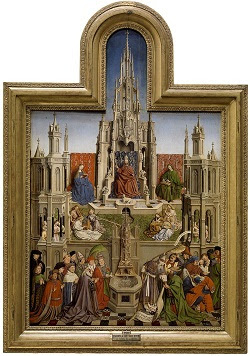
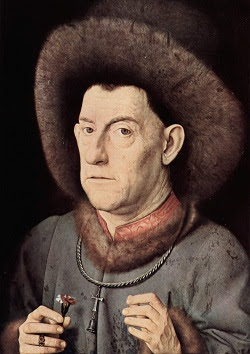
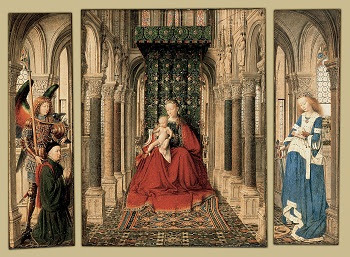
ARTIST OF THE WEEK: 57. Jan van Eyck, ACJ Art Academy


Born: Before 1390; Maaseik, Belgium

Died: 9 July 1441; Bruges, Belgium

Active Years: 1420-1441

Nationality: Flemish

Art Movement: Early Netherlandish painting, Northern Renaissance

Field: Painting

Influenced by: Robert Campin

Influenced on: Rogier van der Weyden, Petrus Christus, Hans Memling


Jan van Eyck was a painter who was one of the early innovators of the style known as Early Netherlandish painting, and one of the most important representatives of Early Northern Renaissance art, born before 1390 and died on July 9, 1441. 

The surviving records show that he was born between 1380 and 1390, most likely in Maaseik, currently in Belgium. At the time, the spelling of this region was “Maaseyck”, whose name came from the region name at the time. 

Around 1422 he became the court painter of John III the Pitiless, duke of Bavaria-Straubing and ruler of Holland and Hainaut at the time. 


John III, Duke of Bavaria


After the death of John III in 1425, he was appointed as court painter of Philip the Good, Duke of Burgundy, and worked in Lille until he moved to Bruges in 1429, where he lived until his death. 
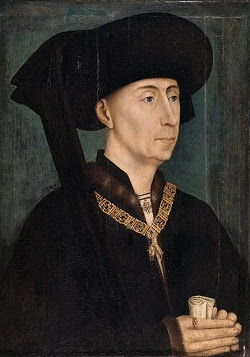

Philip the Good


He was highly regarded by Philip and undertook a number of diplomatic visits abroad, including to Lisbon in 1428 to explore the possibility of a marriage contract between the duke and Isabella of Portugal.


Isabella of Portugal


Van Eyck painted both secular and religious subjects, including altarpieces, religious figures and commissioned portraits. He received generous financial support from Philip, who wanted the painter to have artistic freedom through financial stability and to paint whenever he wanted. 

Van Eyck's work comes from the International Gothic style, but as he emphasized more naturalism and realism, this influence was soon overshadowed. He achieved a new level of virtuosity by developing his techniques in the use of oil paint

He was a highly influential figure, and his techniques and style were adopted and refined by the Early Netherlandish painters.


Painters (Influenced by)


Nativity, Robert Campin


Painters (Influenced on)


Calvary or Crucifixion, Rogier van der
Weyden


The Annunciation, Petrus Christus


Annunciation, Hans Memling


Famous Works (Jan van Eyck)


Thank you.


Amazon Author Page

Lecture Program List

Youtube

Blog (Korean)

Naver TV

Naver Post


Wednesday, June 17, 2020

Interesting Art Stories: 16. Manneken Pis, Jérôme Duquesnoy the Elder, ACJ Art Academy


How are you?

On every Thursday, I am introducing the stories about various artists and their paintings with the title “Interesting Art Stories”.

The 16th story for this week is "Manneken Pis" by the Flemish sculptor Jérôme Duquesnoy the Elder.

Manneken Pis is a statue depicting a naked little boy urinating into the fountain's basin. This 61 cm tall bronze statue is at the junction of the Rue du Chêne and the Rue de l'Étuve, about only five minutes' walk from the Grand Place in Brussels

The statue was created by a Flemish sculptor Jérôme Duquesnoy the Elder in 1619, but the statue we see currently is a replica made in 1965, and the original is kept in the Brussels City Museum.

Manneken Pis fountain, an etching by Jacobus Harrewijn (1697)

Historically, the statue has suffered many times, with repeated thefts or attempted thefts. According to a legend, the statue was found in the Flemish village of Geraardsbergen after being stolen in 1745, and the people of Brussels gave this village a replica of the statue as a token of gratitude for finding it.

The first real attempted theft was made by a group of French grenadiers stationed in Brussels in 1747. The people of Brussels vowed to revenge against the act, but the King of France, Louis XV offered a gentleman's gown of brocade, embroidered with gold to Manneken Pis to soothe the situation.

The statue was later stolen by Antoine Licas, a fugitive in 1817, and he was severely punished as condemned to forced labor for life. During this theft, the original statue was broken into 11 pieces, and the destroyed statue was restored by a professional welder under the supervision of sculptor Gilles-Lambert Godecharle.

Manneken Pis in its niche, fitted in 1770

The statue experienced similar afflictions in the 20th century

Two theft attempts were occurred in 1955 and 1957, and some records say it was stolen seven times. The situation was even more serious when it was stolen in 1965 as the statue was broken by the thief, leaving only the feet and ankles. In June 1966, the magazine "De Post", published in Antwerp, received an anonymous call, stating that the statue was in the Charleroi CanalSubsequently, the statue was found by divers and sent to the magazine, and on June 27 it was returned to Brussels. 

Once again restored, the statue has found an eternal shelter, and the original version is now kept and displayed on the second floor of the Brussels City Museum.

The surroundings of Manneken Pis

There are several legends behind Manneken Pis, but the most famous of which is the story of Godfrey III, Duke of Leuven. In 1142, the troops of the lord Godfrey III, who was one year old at the time, were fighting against the troops of the lord of Grimbergen, in Ransbeke. The troops put the infant lord in a basket and hung the basket in a tree to encourage the fighting troops. From there, the infant lord urinated on the troops of the lord of Grimbergen, who lost the battle.

According to another legend, in the 14th century, Brussels was under siege by a foreign power. The city has resisted for quite some time, so the invaders plan to install explosives on the city walls. Then a little boy named Julianske was spying on them while they were installing explosives. He urinated on the burning fuse and saved Brussels as a result.

Another story, often told to tourists, is about a wealthy merchant who lost his beloved young son while visiting the city with his family. The merchant hurried to form a search party and searched the entire city, where he found his son happily pissing in a small garden. The merchant is said to have built the fountain in return for thanks to the locals who helped during the search.

Today, the statue is one of Brussels' main tourist attractions and you can often see it in clothes. This is because it has become a tradition since the 18th century to wear fancy clothes on this statue. The statue is always receiving new clothes from all over the world, and it is said that there are currently more than 900 clothes in the closet of the statue.

Manneken Pis in judo attire (2008)

A saxophone for Manneken Pis on the 200th birthday of Adolphe Sax (6 November 2014)

Thank you.


Friday, November 8, 2019

22. World Music: Benelux, ACJ Music Academy


How are you?


Following the last week, I am going to start my 22nd lecture.

I had conducted music lectures at Art Collage JANG in Seoul, South Korea every Saturday from March 2015 to December 2017.

I am going to introduce some of the music in the lecture with a brief overview of the lecture by the lecture’s order every Saturday.

Please refer to the following link for my previous lectures.


The 22nd lecture for today is "World Music: Benelux".

This lecture was the 22nd lecture of ACJ Music Academy”, which was held on 12 September 2015.

Benelux is a union of Belgium, the Netherlands and Luxembourg in Europe.

In 1944, exiled representatives of three countries signed “The London Customs Convention” in England, the treaty that established the “Benelux Customs Union”, and then the name began to be used after the three countries.

The treaty came into force in 1948 and covered the elimination of tariffs between the three countries and common tariffs to third countries.

In 1960, the alliance was developed into a “Benelux Economic Union” that ensures the free trade of labor, capital, services and goods in the region.

The Belgian music shows a complex mixture of music of German minorities, immigrants of Democratic Republic of Congo and other countries, as well as Flemish Dutch-speaking and Walloon French-speaking traditions.

For the folk and traditional music, “Bobbejaan Schoepen” was the first Belgian singer to enter the world stage, and recorded folk music singing in Flemish dialect in the 1950s.

Dutch folk music is characterized by a simple and straightforward bass and a style complemented by fast and pleasant melodies.

Unlike folk music from other European countries, Dutch folk music is not the melody but the bass line that is danced to.

This means that although the music itself sounds fast, the dance usually has a medium or slow tempo, and the dance is primarily a group dance rather than individual or dual dances.

In the 1970s, Dutch artists such as Jos Koning, Dommelvolk and Wolverlei led the movement for a “Roots Revival”, and as a result, the revival of folk music in the Netherlands peaked in 1974.

The first reference of Luxembourg music is related to Roman culture and musical style, and most of its musical heritage is closely related to German tradition.

Luxembourg has a long history of dance tradition that reflects many of the dance traditions found in neighboring countries.

However, there are also pure traditional dances of Luxembourg itself, and one of the most famous traditional dances is the dance procession at Echternach.

Today, I will introduce 3 Benelux music as follows:

1. Café Zonder Bier-Bobbejaan Schoepen (Belgium)
2. Jagertje-Wolverlei (Netherlands)
3. Dancing Procession of Echternach (Luxembourg)

You can listen to all the songs from following YouTube link.


Next week, I will be with you with "World Music: Germany" as my 23rd lecture.

Thank you.


🎼 When Paintings Speak Through Music – A Musical Journey Inspired by Picasso's “Guernica”

"Every masterpiece has a melody. Welcome to Melodies on Canvas ." Art records history. Sometimes more powerfully than words....