Author, Lecturer, Broadcaster & Cultural Arts Expert;
President of Art Collage JANG/J Music/J Art/J Books & Media.
Author of over 40 books published on Amazon, including The Crimson Horror series and The Great and Immortal Painters’ Stories series.
Dedicated to sharing insights into art, culture, literature, and creative expression through writing, lectures, media, and content creation.
This week's lecture is “Ludwig
van Beethoven”, the 8th topic of “Classical
Music”, which is a summary of the contents of “93. Classical Music: 8. Ludwig van Beethoven” introduced on June 24th, 2017.
Ludwig van Beethoven,
born on December 17, 1770 and died on March 26, 1827, was a German composer and
pianist, who is one of the most respected composers in the history of Western
music and whose works are among the most performed classical music repertoires.
Beethoven's birthplace, Bonn
His career is divided into early, middle and late periods. The early period,
generally regarded to have lasted until 1802, is the period when Beethoven
gradually forged his talents, and the middle period from 1802 to 1812 was the
period when Beethoven broke away from the classical styles of Joseph Haydn and
Wolfgang Amadeus Mozart and showed an individual development. During this
period, he began to suffer increasingly from deafness. The late period from
1812 to his death in 1827 was a period when Beethoven expanded his innovations
in musical form and expression.
Portrait of Beethoven as a young man,
Carl Traugott Riedel (c. 1800)
Born in Bonn and
exhibiting outstanding musical talent from an early age, Beethoven harshly
received his first musical education from his father, Johann van Beethoven, and
then in 1783, under the guidance of composer and conductor Christian Gottlob
Neefe, who later taught him, published his first work, a set of keyboard
variations.
Johann van Beethoven
Christian Gottlob Neefe
He found relief from living with the family of Helene von Breuning,
whose children he loved, befriended, and taught piano. At the age of 21,
Beethoven moved to Vienna, where later became his base, and studied composition
with Haydn.
Helene van Breuning with her children
Beethoven then gained a reputation as a virtuoso pianist, and soon
he was commissioned from Karl Alois, Prince Lichnowsky, which resulted in his
three Opus 1 piano trios in 1795.
Karl Alois, Prince Lichnowsky
His first major
orchestral work, the First Symphony, was made in 1800, and his first set of
string quartets were published in 1801. During this period, his hearing began
to deteriorate, but he continued to conduct and premiered his Thirdand Fifth
Symphonies in 1804 and 1808, respectively, and composed his Violin Concerto in
1806.
Title page of the Symphony No. 3, "Eroica"
His last piano concerto, No. 5, Op. 73, known as "Emperor", was
dedicated to his frequent patron, Archduke Rudolf of Austria, and premiered in
1810, but was not performed by Beethoven as a soloist.
Archduke Rudolf of Austria
Beethoven, who became
almost completely deaf in 1814, was then forced to give up performing in
public. He wrote about his problems with health and his unfulfilled personal
life in two letters: “Heiligenstadt Testament (1802)” to his brothers, and a
love letter to an unknown “Immortal Beloved (1812)”, which he wrote but
actually unsent.
A facsimile of the Heiligenstadt Testament
Facsimile of the first page of the letter addressed to Immortal Beloved
Beethoven, in the years
from 1810 whose social activity increasingly decreased, composed many of his
most respected works, including his later symphonies, chamber music and piano
sonatas. His only opera, "Fidelio", premiered in 1805, was revised to
its final version in 1814.
Bust of Beethoven, Hugo Hagen (1892)
He composed "Missa Solemnis" in 1819-1823,
and in 1822-1824 wrote his final, Ninth, Symphony, one of the first examples of
a choral symphony, and written in his last years, his late string quartets of 1825–1826
are amongst his final achievements.
Beethoven, who had been bedridden illness for
several months, died on March 26, 1827 at the age of 56, and only his friend
Anselm Hüttenbrenner and Frau van Beethoven, probably his old enemy Johanna van
Beethoven, witnessed his death.
Anselm Hüttenbrenner
An autopsy after his death revealed that
Beethoven suffered from severe liver damage probably from heavy alcohol
consumption and significant dilation of the auditory and other related nerves.
Beethoven on his deathbed, Josef Danhauser
On March 29, 1827,
Beethoven's funeral in Vienna was attended by about 10,000 people, including
Franz Schubert and the violinist Joseph Mayseder, and writer Franz Grillparzer
read a funeral oration.
Beethoven's funeral procession, F. X. Stoeber
Beethoven was buried in the Währing cemetery,
north-west of Vienna after a requiem mass at the church of the Holy Trinity in
Alserstrasse.
Beethoven Monument, Ernst Julius Hähnel, Bonn (1845)
Beethoven's remains were then excavated for study in 1863 and
moved to Vienna's Zentralfriedhof in 1888 where they were reinterred in a grave
adjacent to that of Schubert.
Carl
Maria von Weber was a German composer, conductor, pianist, guitarist and
critic, born on November 18, 1786 and died on June 5, 1826.
Carl Maria von Weber Museum, Dresden
He was one of the
first important composers of the Romantic era. Best known for his operas, he
was a crucial figure in the development of Romantische Oper (Romantic opera), a
genre of German opera in the early 19th century, which developed from the
opéras comiques, not from the German Singspiel.
Statue of Carl Maria von Weber at Theaterplatz, Dresden
In
his youth, his father, Franz Anton, frequently moved to many places with his
family between Hamburg, Salzburg, Freiberg, Augsburg and Vienna. As a result,
he studied with many teachers such as his father, Johann Peter Heuschkel,
Michael Haydn, Giovanni Valesi, Johann Nepomuk Kalcher and Georg Joseph Vogler.
Michael Haydn
He
had a modest output of non-operatic music, including two symphonies, a bassoon
concerto, piano pieces such as Konzertstück in F minor and Invitation to the
Dance, and the pieces that featured the clarinet, usually written for the
virtuoso clarinetist Heinrich Baermann.
Heinrich Baermann
His
operas Silvana (1810), Abu Hassan (1811), Der Freischütz (1821), Die drei
Pintos (1820–21), Euryanthe (1823), and Oberon (1826) had a great influence on
subsequent German composers, including Heinrich Marschner, Giacomo Meyerbeer
and Richard Wagner.
Heinrich Marschner
His piano works anticipated those of Chopin and Liszt, and
his most famous work, Der Freischütz, remains one of the most important German
operas.
Costume designs for Samiel and Caspar in the original production Der Freischütz
Influenced by:
Michael Wolgemut, Martin Schongauer, Antonio del Pollaiuolo, Lorenzo di Credi,
Andrea Mantegna, Nikolaus Gerhaert, Giovanni Bellini
Influenced on:
Raphael, Titian, Parmigianino
Teachers:
Michael Wolgemut, Martin Schongauer
Albrecht
Dürer was a German painter and printmaker who was born on May 21, 1471 and died
on April 6, 1528. He was one of the leading Renaissance painters.
Albrecht Dürer's House in Nuremberg
Born in
Nuremberg, Dürer established his reputation and influence throughout Europe in
his twenties for his high-quality woodcut prints.
He communicated with the
major Italian artists at the time, including Raphael, Giovanni Bellini and
Leonardo da Vinci, and from 1512 he was patronized by Maximilian I, Holy Roman
Emperor.
Portrait of Maximilian I, Albrecht Dürer
Dürer's
vast work includes engravings, prints, altarpieces, portraits, self-portraits,
watercolors and books.
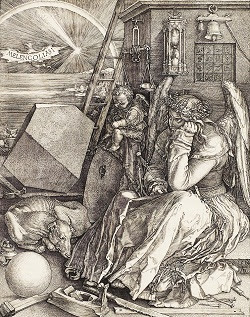
His famous engravings include the three master prints:
Knight, Death and the Devil (1513), Saint Jerome in his Study (1514) and
Melencolia I (1514). He was recorded as one of the first European landscape artists
by his watercolors, and his woodcuts revolutionized the potential of that
medium.
Knight, Death and the Devil, engraving, Albrecht Dürer (1513)
Saint Jerome in His Study, engraving, Albrecht Dürer(1514)
Melencolia I, engraving, Albrecht Dürer (1514)
Dürer
has secured his reputation as one of the most important figures of the Northern
Renaissance by introducing classical motifs into Northern art, through his
affluent knowledge of Italian artists and German humanists.
Monument of Albrecht Dürer, Robert Härtel, Wrocław (1882)
This fame was
further reinforced by his theoretical treatises, including principles of
mathematics, perspective, and ideal proportions.