Author, Lecturer, Broadcaster & Cultural Arts Expert;
President of Art Collage JANG/J Music/J Art/J Books & Media.
Author of over 40 books published on Amazon, including The Crimson Horror series and The Great and Immortal Painters’ Stories series.
Dedicated to sharing insights into art, culture, literature, and creative expression through writing, lectures, media, and content creation.
“Caravaggio” is a 2007
Italian television movie directed by Angelo Longoni. This film is based on the
real life of the Baroque painter Michelangelo Merisi da Caravaggio.
Caravaggio was an Italian painter,
born on September 29, 1571 and died on July 18, 1610, who was active for most
of his artistic life in Rome. In his work, Caravaggio combined the realistic
observation of the physical and emotional state of human, with a dramatic use
of light which influenced on Baroque painting.
Caravaggio's works, which had been
long forgotten after his death, aroused interest again in the 20th century, and
his importance to the development of Western art was reevaluated.
Editor:
Tatyana Egorycheva, Lyudmila Feiginova, Olga Shevkunenko
Cast
Anatoly Solonitsyn as Andrei Rublev
Nikolai Grinko as Daniil Chorny
Nikolai Sergeyev as Theophanes the
Greek
Nikolai Burlyayev as Boriska
Ivan Lapikov as Kirill
Summary
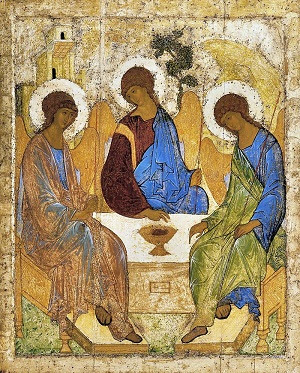
“Andrei Rublev” is a 1969 former
Soviet biographical historical drama film directed by Andrei Tarkovsky and co-written
with Andrei Konchalovsky. The film was remade and re-edited from the 1966 film,
“The Passion According to Andrei” by Tarkovsky which was censored during the
former Soviet Union's Brezhnev regime.
The film is set against the background
of 15th-century Russia and based loosely on the life of the Russian icon
painter Andrei Rublev at the time, but attempts to depict a realistic portrait
of medieval Russia. Tarkovsky tried to make a film that shows the artist as a
world historic figure and Christianity as an axiom of Russian historical
identity during the turbulent period of Russian history, which ultimately led
to the birth of the Tsardom of Russia.
The themes of the film include artistic
freedom, religion, political ambiguity, autodidacticism, and the creation of
art under a repressive regime. For this reason, the film was not released in
the Soviet Union for years after the film was completed.
Then another version
of the film, which was screened at the 1969 Cannes Film Festival, won the
FIPRESCI prize. In 1971, a censored version of the film was released in the Soviet
Union. When it was released in the United States through Columbia Pictures in
1973, the film was further cut for commercial reasons. As a result, the film
has several versions.
Although the film had difficulties due to censorship for
years after the film was released, it has been soon recognized by many film
critics and directors as a highly original and accomplished work. After being
restored to its original version, the film has been regarded as one of the
greatest films of all time, and ranked highly in both critics' and directors'
polls.
Movie
Review
“The Pieta of Filmmaking”
“The Greatest Movie Ever
Made”
“A true masterpiece!”
“Tarkvosky's ingenious”
“The most profoundly
affecting film of my life”
Interesting
stories about the film
1. The film was selected in the
"Religion" category of its list of 45 "Great films"selected by the Vatican.
2. The film was ranked number 40
non-English-speaking film in the 2018 critics' poll conducted by the BBC.
3. The film was included in the
"1001 Movies You Must See Before You Die", edited by Steven
Schneider.
4. Tarkovsky and his
co-screenwriter Andrei Konchalovsky worked for more than two years on the
scripts for the film while studying medieval writings, chronicles and books on
medieval history and art.
5. The film was ranked No. 87 in
the “Essential 100”list of films released by the 2010 Toronto International
Film Festival.
6. The film was ranked #1 in the 25
best arthouse films of all time by the “Guardian.”
"Séraphine" is a 2008
French-Belgian film directed by Martin Provost and written by Marc Abdelnour
and Provost. The film starred Yolande Moreau as the French painter Séraphine
Louis and Ulrich Tukur as Wilhelm Uhde. It won the 2009 César Award for Best
Film.
The film follows the life of
Séraphine Louis, a middle-aged housekeeper, who has a remarkable talent for
painting. Although uneducated in art, she follows the perceptions of religious
inspiration and appreciates the beauty of nature, gazing at trees on her daily
walks to work.
Eminent art critic Uhde, first
meets Séraphine as a housekeeper, but when he sees her painting, he realizes
that she has great talent in painting. Séraphine feels that she is just a
housekeeper and no one will take her seriously, but Uhde tells her that she has
a talent for painting. Then he promises to take care of her and promote her
paintings, telling Séraphine to follow her talents. But Uhde, who was a German,
has to flee from France and leave Séraphine at the time of the war in 1914, but
she continues to do her paintings.
In 1927, Uhde meets Séraphine again
and considers her paintings to be greatly improved. He starts buying her
paintings and gives her a generous salary, encouraging her to do nothing but
paint. However, as the Great Depression progresses, Uhde can no longer sell her
paintings, and Séraphine is frustrated and mentally affected by learning that
Uhde regards her as a means of making money.
After she rouses the town while
wearing her bridal gown, she is locked in a mental hospital and eventually
stops painting. Uhde visits the hospital to meet her but the hospital advises
him not to meet her because it would upset her. He decides to take care of her
and secures her a room in the hospital where she can go outside so that she can
enjoy the beauty of nature again.
Later, in 1942, the death of Séraphine is
revealed, and her works became famous and respected.
Movie
Review
“A visionary artist, her sometime
mentor, and her sad decline”
“Séraphine itself is a work of art”
“An Obsession to Paint”
“Polished enchantment”
“As amazing as the paintings
themselves”
“Loved this true story! Great film!”
“Good French movie”
Interesting
stories about the film
Since the film's release, the
number of visitors at the museum of Senlis exhibiting Séraphine's works has
quadrupled (August 2009).
Running
time: 122 minutes Release date: September 17, 1956
Staff
Director:Vincente Minnelli
Producer:
John Houseman
Screenplay:Norman Corwin
Based
on: “Lust for Life” by Irving Stone
Music:
Miklós Rózsa
Cinematography:
Russell Harlan
Editor:Adrienne Fazan
Cast Kirk Douglas (Vincent van Gogh) Anthony Quinn (Paul Gauguin) James Donald (Theo van Gogh) Pamela Brown (Christine) Everett Sloane (Dr. Paul Gachet) Niall MacGinnis (Roulin) Noel Purcell (Anton Mauve) Madge Kennedy (Anna Cornelia van Gogh)
Summary
“The Lust for Life” is a biographical film
about the life of the Dutch painter Vincent van Gogh, produced in the United
States in 1956, based on Irving Stone's 1934 novel of the same title which was
adapted by Norman Corwin.
It was directed by Vincente Minnelli and
produced by John Houseman. The film stars Kirk Douglas as Van Gogh, James
Donald as his brother Theo, along with Pamela Brown, Everett Sloane, and
Anthony Quinn. Douglas won the Golden Globe Award for Best Actor, and Quinn won
the Academy Award for Best Supporting Actor.
Movie
Review
“An Accurate Biopic”
“A fantastic biographical movie”
“The Best Hollywood Biopic”
“Passion for life”
“Too Sensitive For This World”
“A great film by a great Director - but not
a true biography”
“Remarkable performance by bigger than life
Kirk Douglas...”
Interesting
stories about the film
1. Many of the places used for filming were
the places that Vincent van Gogh actually visited in his life.
2. The color process used for the film was
not suitable for long-term color preservation. As a result, revival prints lost
the brightness and range of the film’s original images. Fortunately, however,
the original colors were properly restored in the DVD edition.
3. A very young Michael Douglas watched
this film with his brother Joel in the theater. In the scene where Van Gogh
cuts his own ear, they thought that his father had actually cut his ear, and
the two ran away screaming. 4. Many people claim that Anthony Quinn appeared in the movie for only 8 minutes and won the Oscar for his Best Supporting Actor, but his actual appearance time was 22 minutes and 40 seconds.
5. Parts of the film were shot in Auvers-sur-Oise,
where Vincent van Gogh died. At that time Kirk Douglas cut his hair in the
style of Van Gogh and dyed it in a similar reddish color. Some of the old people
in the city who saw this thought that Van Gogh had returned.
6. On December 17, 1955, Perry Como, who
appeared as a barber at his TV show on NBC, shaved off Kirk Douglas' beard he grew
for this picture on live TV.
7. There is no exact evidence that the 'Wheatfield
of Crows' is Van Gogh's last painting. Some people claim that the last one is 'Tree
Roots' or 'Daubigny's Garden'.
8. The name “Theo” is an American
pronunciation. The more accurate Dutch pronunciation is “TAY-oh”.