Author, Lecturer, Broadcaster & Cultural Arts Expert;
President of Art Collage JANG/J Music/J Art/J Books & Media.
Author of over 40 books published on Amazon, including The Crimson Horror series and The Great and Immortal Painters’ Stories series.
Dedicated to sharing insights into art, culture, literature, and creative expression through writing, lectures, media, and content creation.
Following the last week, I am going to start my 76th
lecture.
Today's lecture is “New Acoustic”, the third topic of
“New Age Music”, which is a summary of the contents of “76. New Age Music: 3.
New Acoustic” introduced on February 18th, 2017.
“New Acoustic” is a music genre that mixes the influences of folk
music, bluegrass, jazz and world music. It is characterized by using only
acoustic instruments and being led by musical instruments such as mandolin,
fiddle, banjo and acoustic guitar. New Acoustic, which began in the 1970s, is
the music of universal atmosphere not for specific people but for anyone who
want to enjoy.
The representative record label of this genre is Windham Hill,
which recorded and produced as concept of acoustic music different from the
existing one.
Windham Hill
In addition to Windham Hill, musicians belonging to Narada and
Private Music labels are also mainly contributing to this genre.
Narada
Private Music
Representative
American musicians in this genre include Bela Fleck, a banjo player; Leo
Kottke, an acoustic guitarist and famous for finger picking based on blues,
jazz and folk music; Tony Rice, a guitarist and bluegrass musician who had the
greatest influence on bluegrass and acoustic jazz among living acoustics
guitarists; Mike Marshall, a bluegrass mandolinist and considered as mandolin's
virtuoso; and Darol Anger, a violinist and founding member of The David Grisman
Quintet.
Béla Fleck
Leo Kottke
Tony Rice
Mike Marshall
Darol Anger
You can also review this lecture from following media.
Release
date:7 September 1998 (Venice Film Festival), 9
September 1998 (France)
Staff
Director:
Roger Planchon
Produced by:Margaret Ménégoz
Screenplay: Roger Planchon
Cinematography:Gérard Simon
Music:Jean-Pierre Fouquey
Editor:
Isabelle Devinck
Cast
Régis Royer as Henri de
Toulouse-Lautrec
Elsa Zylberstein as Suzanne Valadon
Anémone as Comtesse Adèle de
Toulouse-Lautrec
Claude Rich as Comte Alphonse de
Toulouse-Lautrec
Hélène Babu as La Goulue
Karel Vingerhoets as Vincent van
Gogh
Régis Royer
Elsa Zylberstein
Summary
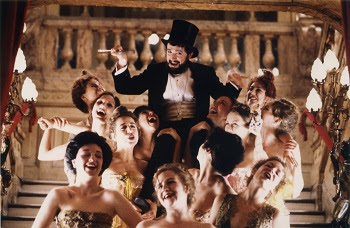
"Lautrec" is a 1998
French-Spanish biographical film about the French painter Henri de
Toulouse-Lautrec.
Henri de Toulouse-Lautrec
Directed by Roger Planchon, the film focuses on his love with
painter Suzanne Valadon, and it was shown at the 1998 Venice Film Festival.
Self-Portrait, Suzanne Valadon (1898)
Lautrec was a French painter born
on November 24, 1864 and died on September 9, 1901, who is one of the most
famous Post-Impressionist painters along with Paul Cézanne, Vincent van Gogh,
Paul Gauguin and Georges Seurat.
Portrait of Vincent van Gogh, Henri de Toulouse-Lautrec (1887)
After moving to Paris in 1882, he
studied from Léon Bonnat and was fascinated by Montmartre, famous for its
bohemian lifestyle. Later, he moved to Fernand Cormon’s studio, where he met
friends for the rest of his life. At this time, he also met Émile Bernard and
Vincent van Gogh.
Fille romaine à la fontaine, Léon Bonnat (1875)
Going Fishing, Fernand Cormon (1888)
Lautrec met Suzanne Valadon in 1885, and he painted several
portraits of her and supported her ambition as an artist. It is said that the
two were lovers and she wanted to marry him, but when their relationship ended,
Valadon attempted suicide.
Portrait of Suzanne Valadon, Henri de Toulouse-Lautrec (1885)
On every Thursday,
I am introducing the stories about various artists and their paintings with the
title “Interesting
Art Stories”.
The 38th story for
this week is “Le
Déjeuner sur l'herbe” by Édouard Manet.
Édouard Manet
“Le
Déjeuner sur l'herbe” originally titled “Le Bain” is an oil painting by Édouard
Manet on a large canvas (208 cm × 264.5 cm) completed in 1863. This painting
depicts a female nude and a scantily dressed female bather enjoying a picnic
with two fully dressed men in the countryside.
Manet exhibited this painting,
which was rejected by the Salon in 1863, at the Salon des Refusés in the same
year, where the painting provoked a great debate with the public criticism. The
painting is now in the Musée d'Orsay in Paris, and a smaller, earlier version
(89.5 cm x 116.5 cm) is in the Courtauld Gallery in London.
Déjeuner sur l'herbe, Édouard Manet (Courtauld)
Despite the mediocre
subject, Manet deliberately used a large canvas for this paintings, generally
used for historical, religious and mythological subjects.
Manet often used real models
and people he knew for his paintings. The female nude in this painting is
presumed to be Victorine Meurent, the woman who became his favorite and
frequently modeled, who later was the subject of “Olympia.” The man on the
right is believed to be a combination of his two brothers, Eugène and Gustave
Manet, while the other man is believed to be his brother-in-law, Dutch sculptor
Ferdinand Leenhoff.
Portrait of Victorine Meurent, Édouard Manet
Olympia, Édouard Manet
Like many of his works,
including "Olympia," Manet's paintings reflects his study about the
old masters, such as the disposition of figures derived from "The Judgment
of Paris", which is Marcantonio Raimondi's engraving after a drawing by
Raphael.
Judgement of Paris, Marcantonio after Raphael
Scholars also refer to two
works as important precedents of this painting: “The Pastoral Concert” by
Giorgione (or Titian) and “The Tempest” by Giorgione.
“The
Tempest”, featuring a fully dressed man and a nude woman in a rural area,
offers an important precedent for this painting, and “The Pastoral Concert”, featuring
two dressed men seated in a rural setting with two undressed women, is much
more similar to Manet's painting than “The Tempest”. Also, since the “The
Pastoral Concert” is a collection of the Louvre in Paris, it is very likely
that Manet had seen and studied the work.
The Tempest, Giorgione
The Pastoral Concert, Giorgione or Titian
A connection between this
painting and Jean Antoine Watteau’s "La Partie Carrée" was also
argued among scholars. The woman bathing alone in Manet's painting is also very
similar to the woman in Watteau's “La Villageoise”, and the possibility that
Manet adopted her pose in Watteau’s work is more clearly seen in a sketch
before creating this painting.
La Partie Carrée, Antoine Watteau
La Villageoise, Antoine Watteau
There are some works
inspired by this painting as follows:
1. Claude Monet's“Le
Déjeuner sur l'herbe” was inspired by this painting.
Le Déjeuner sur l'herbe, Claude Monet
2. French painter James
Tissot’s“La Partie Carrée” seems to be a non-nude version of this painting.
La Partie carrée, James Tissot
3. Paul Cézanne painted the
same theme in his “Le Déjeuner sur l'herbe”, at the Musée de l'Orangerie in
Paris.
Le Déjeuner sur l'herbe, Paul Cézanne
4. Picasso adopted some of
Manet's techniques, including the development of the nude in the foreground in
“Les Demoiselles d'Avignon.”
Les Demoiselles d'Avignon, Pablo Picasso
5. Paul Gauguin may have
been inspired by this painting in his “Where do we come from? Who are we? Where
are we going?”
Where Do We Come From? What Are We? Where Are We Going?, Paul Gauguin
6. German painter Max Ernst
painted a parody version of this painting named “Le Déjeuner sur l'Herbre” in
1944.
Le Déjeuner sur l'Herbre, Max Ernst
7. This painting inspired
1959 film of the same name by Jean Renoir.
Film poster "Le Déjeuner sur l'herbe", Jean Renoir
8. French artist Alain
Jacquet copied this painting in 1964 in his “Déjeuner sur l'herbe.”
Déjeuner sur l'herbe, Alain Jacquet
9. British New Wave band Bow
Wow Wow copied this painting in the cover photo of their albums “See Jungle!
See Jungle! Go Join Your Gang Yeah, City All Over! Go Ape Crazy!” and “The Last
of the Mohicans.”
Album "See Jungle! See Jungle! Go Join Your Gang Yeah, City All Over! Go Ape Crazy!", Bow Wow Wow