Showing posts with label Giorgione. Show all posts

Sunday, October 11, 2020

ARTIST OF THE WEEK: 49. Titian, ACJ Art Academy


Born: c. 1488/90; Pieve di Cadore, Italy 

Died: 27 August 1576; Venice, Italy
Active Years: 1505 - 1576
Nationality: Italian
Art Movement: High Renaissance, Mannerism (Late Renaissance)
Field: painting
Influenced by: Albrecht Durer, Giorgione, Raphael, Michelangelo
Influenced on: Jacopo Bassano, Peter Paul Rubens, Diego Velazquez, Caravaggio, Rembrandt, Nicolas Poussin, Edgar Degas, Anton Raphael Mengs, Anthony van Dyck, John Singer Sargent, William Dobson, Claudio Coello, Palma Vecchio, Palma il Giovane, Joshua Reynolds
Teachers: Giovanni Bellini, Gentile Bellini
Pupils: El Greco, Annibale Carracci, Tintoretto
Friends/Co-workers: Giorgione, Lorenzo Lotto

Titian was an Italian painter during the Renaissance, born around 1488/90 and died on August 27, 1576. He is considered one of the most important painters of the 16th-century 
Venetian school. Born in Pieve di Cadore, near Belluno, Titian was often called “da Cadore”, which derived from the name of his hometown.

Pieve di Cadore, Veneto, Italy


Recognized by his contemporaries as "The Sun Amidst Small Stars", Titian was one of the most versatile Italian painters versed in portraits, and mythological and religious subjects. His painting methods, particularly in the use of colors, had a great influence not only on painters in the late Italian Renaissance period, but also on future generations of Western art. 

Titian died of a fever during an epidemic outbreak in Venice. His body was buried in the Basilica di Santa Maria Gloriosa dei Frari, and his unfinished work "Pietà" was completed by Palma il Giovane. He lies near his famous painting, “Madonna di Ca' Pesaro (Pesaro Madonna).”

Pietà (c.1576)


Pesaro Madonna,(1519–1526)


Tomb of Titian


Thank you. 

Amazon Author Page
Lecture Program List
YouTube
Blog (Korean)
Naver TV
Naver Post 


Wednesday, October 7, 2020

Interesting Art Stories: 31. The Tempest, Giorgione, ACJ Art Academy

How are you? 

On every Thursday, I am introducing the stories about various artists and their paintings with the title “Interesting Art Stories”.

The 31st story for this week is “The Tempest” by Giorgione, an Italian painter of the High Renaissance. 

Giorgione


“The Tempest” is a Renaissance painting by the Italian master Giorgione between 1506 and 1508, commissioned by the Venetian noble Gabriele Vendramin. Also known in Italy as "The Gypsy woman and the soldier" or "The Gypsy girl and the soldier", the painting is now in the Gallerie dell'Accademia in Venice, Italy. 

Gallerie dell'Accademia, Venice, Italy


The meaning of the painting is unknown and the painting remains the world’s most enigmatic painting, despite considerable debate and discussion among art historians.

A woman sits and feeds her baby beneath a thunderous sky outside the walls of an unnamed city. The woman's posture in the painting is unusual, normally when feeding the baby, the mother places the baby on her lap, but in this painting the baby appears to be on the mother's side. 

A man, holding a long stick to the left of the painting, is standing in balance with the woman to the right of the painting. He is looking at the left with a smile, but does not seem to be looking at the woman. 

The woman has been described as a gypsy, a prostitute, or Eve, and the man as a soldier, a shepherd, a gypsy or a young aristocrat. One interesting fact of this painting is the results of the X-rays that another nude woman was originally painted in the man’s place. On the rooftop on the right of the painting, there is a stork, which sometimes represents the love of parents for their children. 

This painting seems to anticipate the storm when referring to a thunderous sky with lightning. The green and blue colors dominate the painting and the lighting is soft. In addition, the landscape is not a mere background, but makes a significant contribution to this painting.

There are no definitive explanation or interpretation left in documents for this painting. 

Some people claim that the painting represents the flight into Egypt, the contents of the Bible where Joseph and Mary fled to Egypt with the infant Jesus to escape the persecution of King Herod, while others claim that it is a scene from the Greek mythology such as Paris of Troy and his wife Oenone, or Iasion, the son of Electra and Zeus, and Demeter, the goddess of the harvest and agriculture, who gave birth to his sons, or from an ancient Greek pastoral novel.

The Flight into Egypt, Giotto di Bondone (1304–1306)


Paris and Oenone, Pieter Lastman (1619)


There is also another claim that the
city in the painting represents the Paradise, and the man and woman are Adam and Eve with their son Cain. In this case, the lightning would represent God who expelled them from the Garden of Eden. Others also claim that it is a scene from a moral allegorical book, or that Giorgione simply painted without a particular subject in mind. 

Adam and Eve, Jacob Jordaens (1640s)


There is one anecdote about this painting: in September 1943 Professor Pasquale Rotondi, an Italian art historian, famous for having saved about 10,000 Italian works of art from the destruction and looting of Nazi troops during World War II, hid this painting under his bed and was able to protect it from German troops.

It is said that this was Lord Byron's favorite painting because the ambiguity of both its theme and symbol of the painting allowed viewers to create their own stories.

Also, Jan Morris, a Welsh writer, wrote that this painting changed the way she looked at painting. Fascinated with the subject of this painting and the enigmatic feeling that permanently stays with it, she called it a "haunted painting" in which the dead Giorgione actually inhabits.

Thank you.

Amazon Author Page
Lecture Program List
YouTube
Korean Blog
Naver TV
Naver Post 


Saturday, September 19, 2020

ARTIST OF THE WEEK: 47. Lorenzo Lotto, ACJ Art Academy


Born: c.1480; Venice, Italy 

Died: 1556; Loreto, Italy 

Nationality: Italian

Art Movement: High Renaissance

Field: Painting

Influenced by: Giovanni Bellini, Giorgione

Friends/Co-workers: Titian


Lorenzo Lotto was an Italian painter and traditionally included in the Venetian school, though he spent much of his career in other northern Italian cities. He was active during the High Renaissance and the first half of the Mannerist period. He mainly painted altarpieces, religious subjects and portraits. Although his nervous and eccentric poses and distortions in his work represent a transitional stage to the Florentine and Roman Mannerists, his works generally maintained a style similar to that of the High Renaissance throughout his career.

Lotto was a respected painter during his lifetime and was certainly a popular painter in Northern Italy. He is traditionally included in the Venetian school, but based on his independent career, he is actually included outside the Venetian art world. Because of his stylistic individuality and idiosyncratic style, he was not as highly regarded in Venice as in the other cities where he worked. After his death, Lotto gradually became neglected and eventually almost forgotten in people's memory. These people's oblivion about him can be guessed by the fact that his works now remain in lesser-known churches or provincial museums.


FAMOUS WORKS


ALL WORKS LIST (Lorenzo Lotto)


RELATED ARTISTS

1. Giovanni Bellini


2. Giorgione


3. Titian


ALL ARTISTS LIST


Thank you.


Amazon Author Page

Lecture Program List

YouTube

Blog (Korean)

Naver TV

Naver Post


Saturday, September 12, 2020

ARTIST OF THE WEEK: 46. Giorgione, ACJ Art Academy


Born: c. 1477/78; Castelfranco Veneto, Italy
Died: 1510; Venice, Italy
Nationality: Italian
Art Movement: High Renaissance
Field: Painting
Influenced by: Giovanni Bellini
Influenced on: Titian, Lorenzo Lotto, Caravaggio, Palma Vecchio
Pupils: Sebastiano del Piombo
Friends/Co-workers: Titian

Giorgione was an Italian painter during the High Renaissance. Born circa 1477/78 and died in 1510, he was one of the important artists of the Venetian school.

Although there are only about six surviving works that have been confirmed as his own work, he is famous for his mysterious and difficult-to-understand poetic paintings. The uncertainty surrounding the identity and meaning of his work has made Giorgione one of the most mysterious figures in European art.

Together with Titian, he further developed the Venetian school, which has established a unique style with color and mood since Giovanni Bellini.

Although he died at the young age of his thirties, Giorgione left a legacy developed by Titian and 17th-century artists

Although controversial, he was the first Italian artist to paint landscapes with figures as vibrant paintings in their own frames, with no religious, allegorical or historical purpose.

FAMOUS WORKS


RELATED ARTISTS

1. Giovanni Bellini

2. Titian

3. Lorenzo Lotto

4. Caravaggio


Thank you.


Saturday, August 29, 2020

ARTIST OF THE WEEK: 44. Giovanni Bellini, ACJ Art Academy


Born: c.1430; Venice, Italy
Died: 1516; Venice, Italy
Active Years: 1450 - 1516
Nationality: Italian
Art Movement: Renaissance
Field: painting
Influenced on: Antonello da Messina, Bartolomeo Veneto, Palma Vecchio, Albrecht Durer
Pupils: Giorgione, Titian, Sebastiano del Piombo
Friends/Co-workers: Albrecht Durer
Family/Relatives: Jacopo Bellini, Gentile Bellini, Andrea Mantegna

Giovanni Bellini was an Italian Renaissance painter, born around 1430 and died on November 26, 1516. He was the most famous of the Bellini family of Venetian painters. His father was Jacopo Bellini, his brother was Gentile Bellini, who was more highly regarded than Giovanni during his lifetime, and his brother-in-law was Andrea Mantegna

He is considered to have revolutionized Venetian painting by transforming it with a more sensuous and coloristic style. Giovanni used a clear, slow-drying oil paints to create deep, rich tints and detailed shadings. His sumptuous coloring and atmospheric landscapes had a great influence on the Venetian painting school, especially on his pupils Giorgione and Titian.

FAMOUS WORKS


RELATED ARTISTS

1. Albrecht Durer

2. Giorgione

3. Titian


Thank you.


Wednesday, July 15, 2020

Interesting Art Stories: 20. Rokeby Venus, Diego Velázquez, ACJ Art Academy


How are you?

On every Thursday, I am introducing the stories about various artists and their paintings with the title “Interesting Art Stories”.

The 20th story for this week is The “Rokeby Venus” by the Spanish painter Diego Velázquez.

Diego Velázquez

The Rokeby Venus” is a painting by Diego Velázquez, one of the leading artists of the Spanish Golden Age. Completed between 1647 and 1651 and presumed to have been drawn when Velázquez visited Italy, this work depicts the goddess Venus in a sensual pose, lying on a bed and looking at a mirror held by her son Cupid

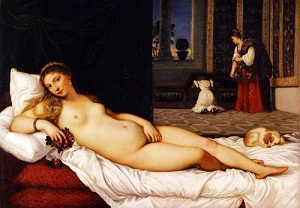
Many of the paintings from the ancient to the Baroque inspired Velázquez to draw this painting. Some of the important precedents are the nude Venuses of the Italian painters such as Giorgione's “Sleeping Venus” (c. 1510) and Titian's “Venus of Urbino” (1534). This painting is the only surviving piece of female nude painting by Velázquez, and one of his most controversial, as well as one of his best works. 

Sleeping Venus, Giorgione (c. 1510)

Venus of Urbino, Titian (1534)

In the 17th-century Spanish art when Velasquez drew this painting, nude paintings were extremely rare, and these were the subject to surveillance by the Spanish Inquisition. At the time, the Spanish Inquisition had a lot of discussion about what was allowed and what wasn’t in the paintings, and nude paintings were included in the “naughty” list. Therefore, it was common for artists who painted the nudes to be fined, excommunicated, and their works seized. 

In the case of Velasquez, he could get away from it only because he was under the patronage of the Spanish king, Philip IV. Nevertheless, it is ironic that foreign artists' nude paintings were keen collection of the court circle at the time. 

This painting was hung in the houses of Spanish courtiers and moved to the Rokeby Park in England in 1813, staying there for almost a century and then has been held by the National Gallery in London since 1906

The National Gallery

There are many paintings influenced by this painting, one of which is “Olympia” painted by Édouard Manet in 1863. Manet paraphrased the Rokeby Venus by drawing a real woman as a model, not an ethereal goddess. 

Olympia, Edouard Manet (1863)

The “Rokeby Venus” is also a painting that was badly damaged in a malicious attack and became a headline again in 1914. On March 10, 1914, the suffragette Mary Richardson entered the National Gallery and attacked Velázquez's painting with a meat knife. 

Mary Richardson

Although there were advance warnings that there would be a planned suffragette attack on the painting, her action was provoked to protest the arrest of fellow suffragette Emmeline Pankhurst the previous day. Richardson's attack damaged the painting, but it was successfully restored by Helmut Ruhemann, a painting restoration expert at the National Gallery.

Emmeline Pankhurst

Richardson was sentenced to six months' imprisonment, the maximum allowed for destroying an artwork. Shortly after the incident, she explained the reason of her attack in a statement to the Women's Social and Political Union, "I tried to destroy the picture of the most beautiful woman in mythological history as a protest against the Government for destroying Mrs. Pankhurst, who is the most beautiful character in modern history."

Damage sustained in the attack by Mary Richardson in 1914

Thank you.


“Teach My Heart to Stay” | Female Vocal Jazz

A smoky, romantic original female vocal jazz song inspired by the golden atmosphere of classic jazz clubs. “Teach My Heart to Stay” blend...